
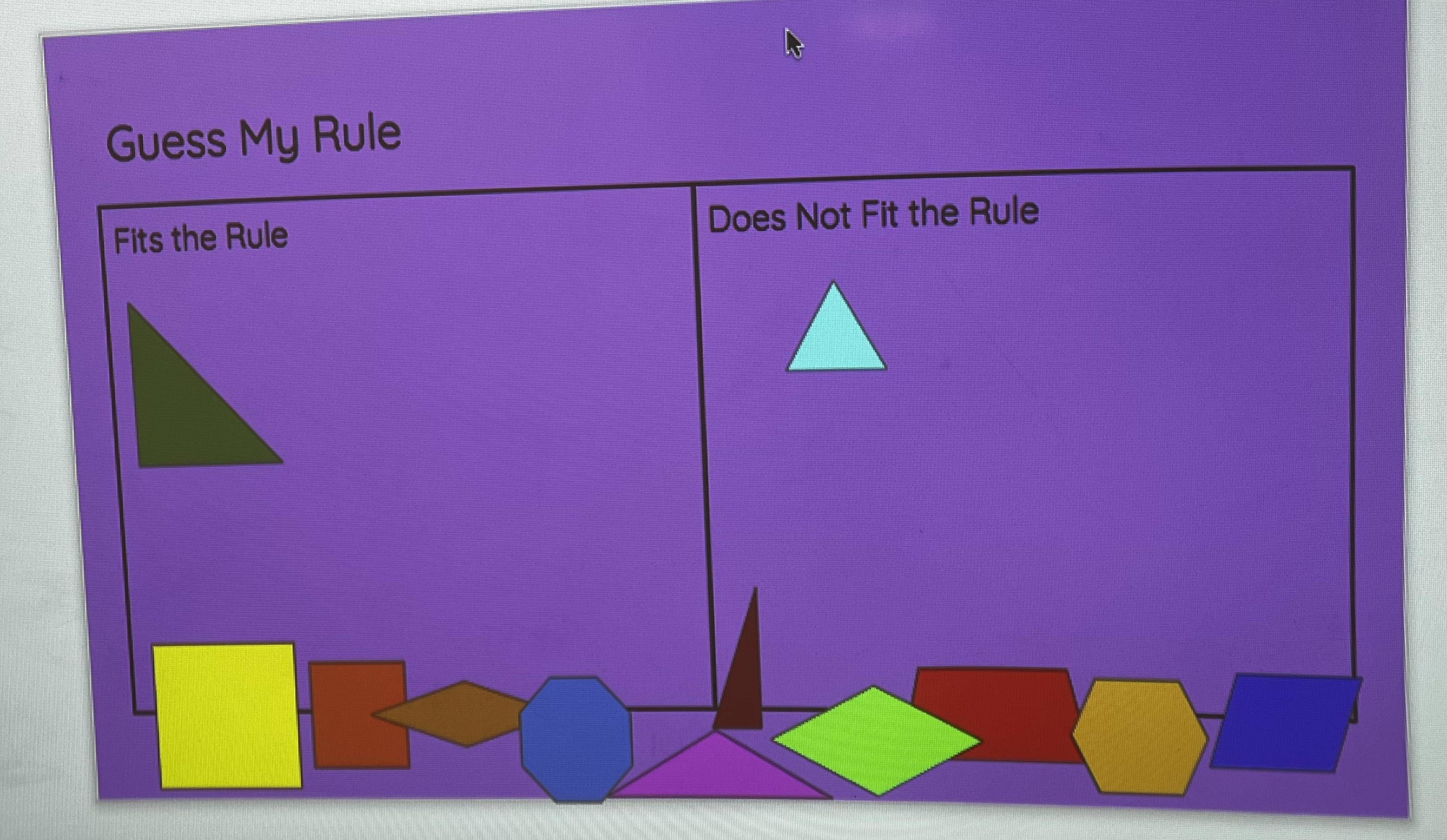
“This shape fits my rule,” said 4th grade teacher Ms. Cohen, moving the green right triangle to the left side of the board. “And this shape,” she continued, dragging the blue equilateral triangle” doesn’t fit my rule. Does anyone want to try to place another shape?
Isaac immediately raised his hand. “I think the half-triangle fits the rule!”
Ms. Cohen paused. “Wait, which one is the half-triangle?”
“The dark brown one, in between the blue stop sign and the green rhombus.”
I chuckle a little, behind my mask. A half-triangle is, of course, just a triangle. A triangle is a three-sided polygon. Any line going from one side to the another, partitioning that triangle into two parts, will inherently create a third side. And that third side makes it a triangle.
“Say more about that half-triangle,” I continued. “What makes it a half-triangle?”
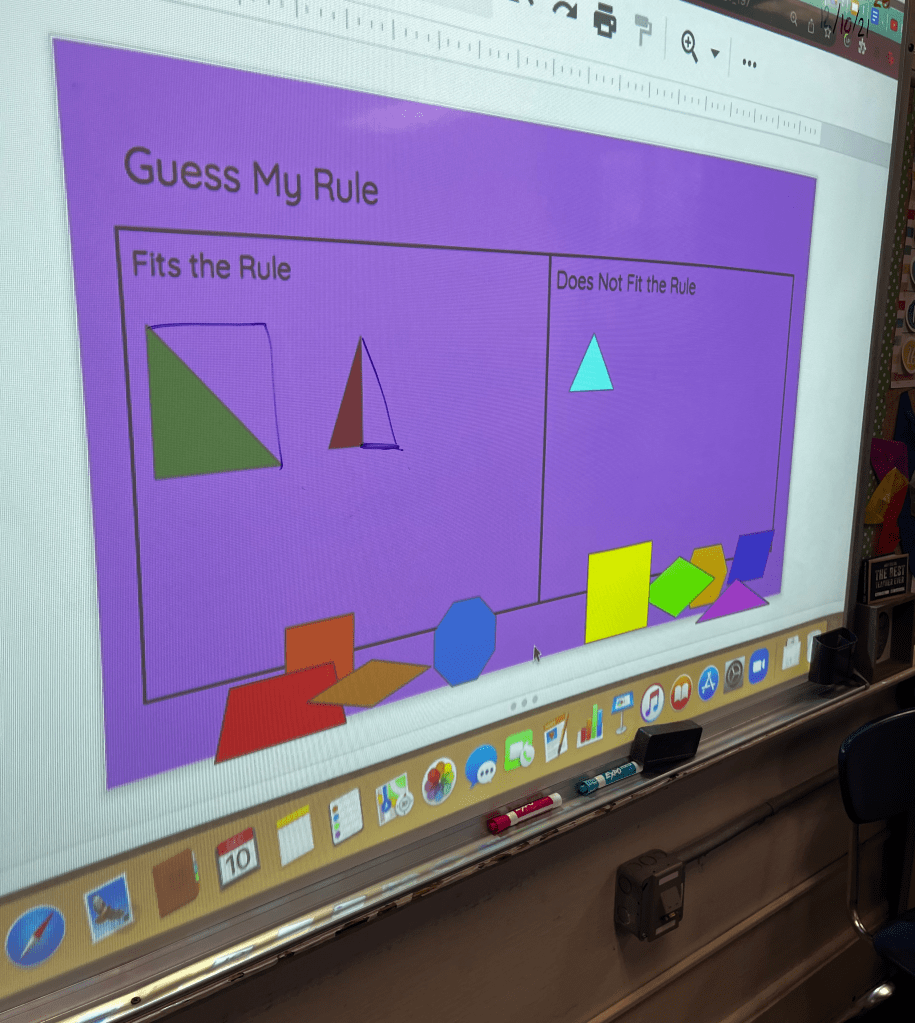
Isaac explained that you can double it to create a triangle. “But if you double the other one that fits the rule, you get a square.” He paused dramatically. “Maybe the rule is ‘you can double the shape to make another shape!'”
Learning Progression
These ideas about ‘doubling’ may have been built up in the primary grades with work on creating composite shapes (CCSS 1.G.A.2) and decomposing shapes into fractional parts. I wrote about this work a few weeks ago, in “Digging in the Closet: The Return of the Museum of Rarely Used Math Manipulatives (MoRUMM).”
Later, in sixth grade, students learn how to find the area of polygons by decomposing, rearranging, and composing shapes. They start with rectangles — using the familiar length • width — and then explore how parallelograms can be decomposed to form rectangles.

From there, students discover that triangles and parallelograms have an interesting relationship. Doubling the triangle and placing it along any of the side lengths results in a parallelogram. Or: parallelograms can be decomposed into two congruent triangles.
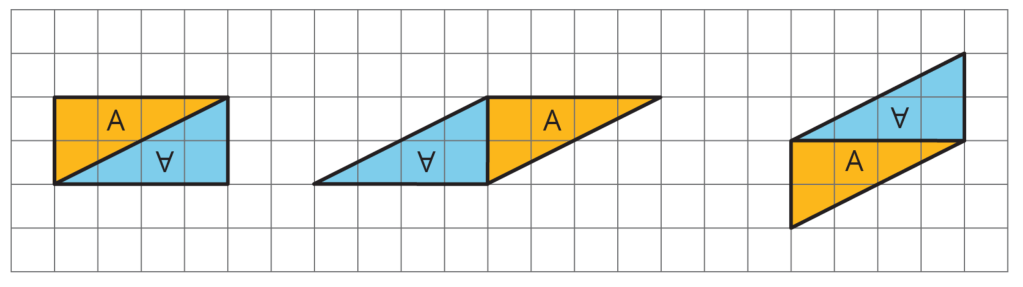
What Happens When We Double a Shape?
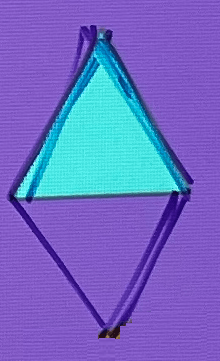
“But what about the blue triangle?” Liam asked. I noticed that most of the kids referred to these particular shapes by their color name followed by the name based on their sides, e.g. triangle or hexagon. This was less true for quadrilaterals. “If you double it, it makes a shape, but it doesn’t fit the rule.”
Students continued to add shapes to the ‘fits the rule’ and ‘does not fit the rule’ columns. Mila put a square under ‘fits the rule.’ (It did.) Arjun put an isosceles obtuse triangle under ‘fits the rule.’ (It didn’t.)
No one in the class seemed to know what the rule might be.
Isaac raised his hand again. “What if we don’t double the triangle like the way you drew. What if we double it another way. Then it makes a rectangle.”
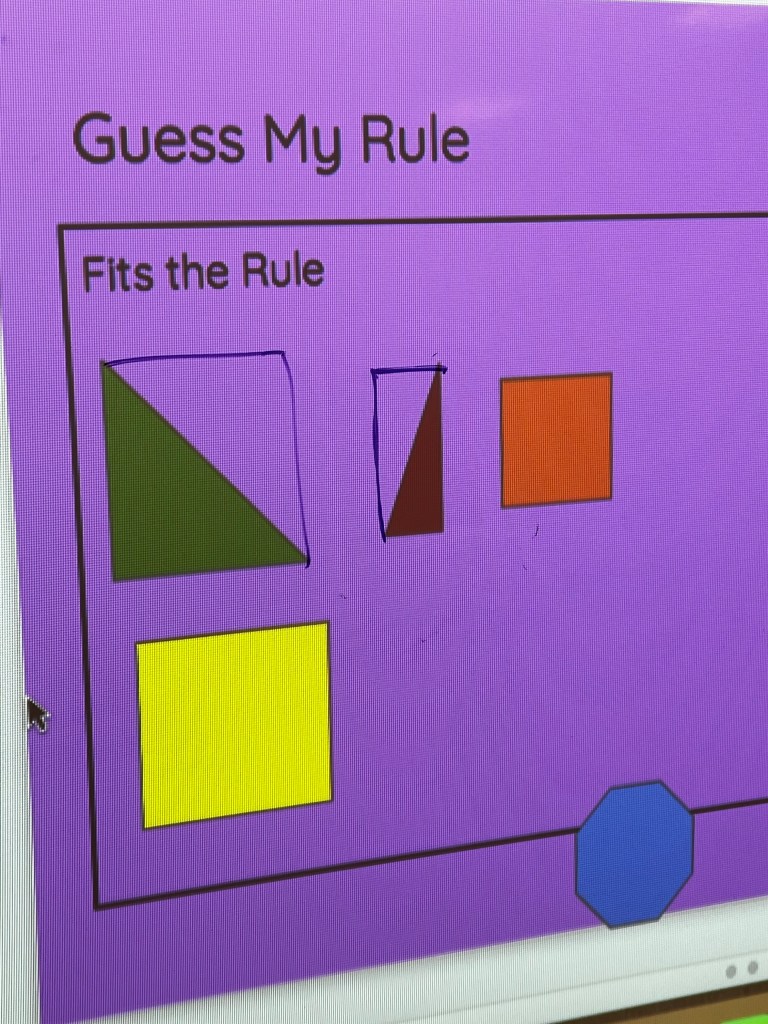
I asked if this matched his thinking. It did.
“I think you can do the same thing to the squares,” Isaac continued.
“Oh!” Declan’s guttural interjection was the aural equivalent of a lightbulb going off over his head. “I think I know the rule! Is it that you can add the same shape to make a 4 corner shape?”
“Let’s try!” I responded gamely. The class helped me double some of the shapes.
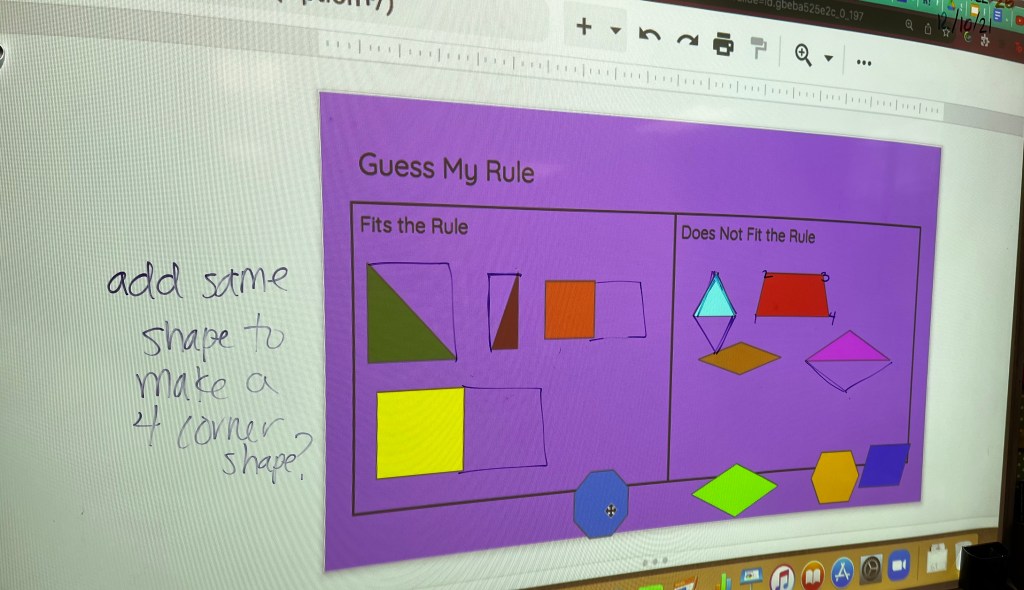
Hmm. It didn’t seem to work.
I watched several students squint. I imagine that, under their masks, their lips were pursed in thought.
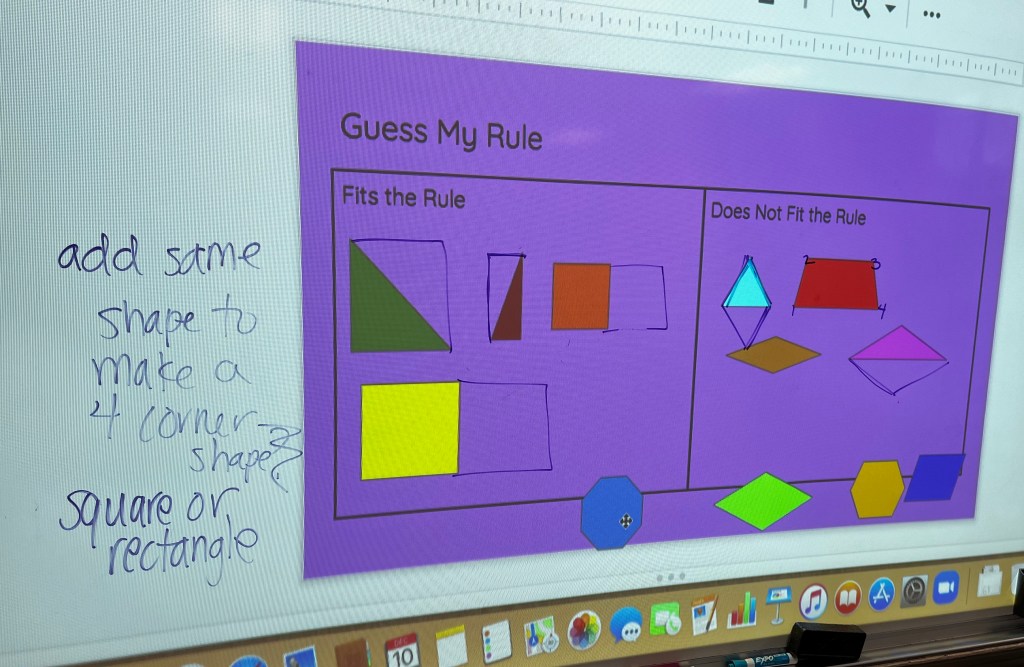
“The ones that fit the rule only make squares and rectangles,” Arjun noted. “The ones that don’t fit the rule make rhombuses and stuff.”
Mathematical Language and Intuition
Arjun had actually stumbled on the rule implicitly. The reason those shapes formed squares and rectangles specifically, and not just any ol’ parallelogram, is because they have right angles.
We were getting closer!
“What’s true about both squares and rectangles?” I queried. “Something that’s not true about rhombuses, even though rhombuses also have 4 corners…”
“They look kind of perfect,” Logan said. “The rhombuses are all… pointy.” His eyes looked like he was searching for the words.
Students were having all of these ideas about the properties of these shapes intuitively. We had only briefly introduced the idea of parallel and perpendicular lines in the previous lesson, but they didn’t seem to be using those words just yet. They were using a mix of formal mathematical language and their own natural language. The figures that fit the rule weren’t pointy if you doubled them, even though some of the triangles were pointy on their own. What was that about?
Then, Priya remembered a word we had used the day before, when we were learning about the definition of a polygon. Polygons are closed figures made up of straights lines that don’t…
“Intersection!” Priya blurted out. “It has to do with the intersections!”
Priya was onto something, although her terminology wasn’t exactly precise. She was looking at the angles, formed by two line segments joined together. I extended those line segments to form intersections. As I drew them, Ms. Cohen continued to probe their thinking.
“That reminds me of some words we learned about yesterday,” Ms. Cohen suggested. “We learned about how lines can be related.” She held up her arms to model parallel lines, and then perpendicular lines, without saying a word.
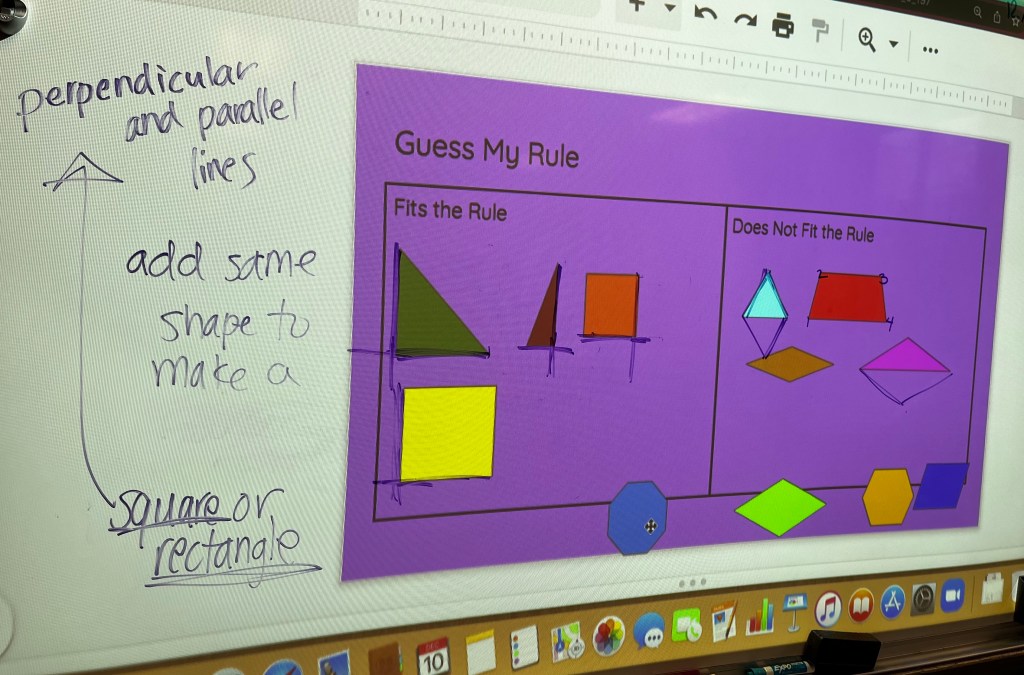
Isaac waved his hand urgently. “Perpendicular and parallel lines! The shapes the fit the rule all have perpendicular and parallel lines when you add the same shape! The ones that fit the rule only have parallel lines when you double them!”
What IS the Rule?
Ms. Cohen had intended for the rule to be ‘has a right angle.’ (This example was straight from the Investigations teaching guide.) At no point in the conversation did students use the word ‘angle,’ and they certainly didn’t clarify to say ‘right angle.’
All the same, these fourth graders had managed to winnow down their definition to one that is inclusive of shapes with a right angle. However, their definition would actually exclude some shapes with a right angle. For example:

This hexagon has a right angle. It is possible to double this shape and preserve the right angle, like so:

The above shape continues to have both parallel and perpendicular lines. However, it is also possible to double the shape without preserving the right angle.

This shape continues to have parallel lines, but it has lost its perpendicular lines. So was their defined rule ‘good enough?’
Ms. Cohen whispered to me, “I think we need to move on, so we have time for the next activity.” (She was right.) Students would be making composite shapes out of two or more power polygons, after which we’d have a conversation about the names of shapes. (e.g. “All of these 3-sided polygons are different, but they’re all triangles. We name shapes based on their number of sides or angles.”)
So the students never got to the rule being about right angles, and I think that’s more than okay. They had this beautiful experience refining their ideas and using increasingly precise language. They did so collaboratively.
Attributes and Language Over Time
Right before we transitioned to the next activity, Priya asked a brilliant question. “So all of them have perpendicular lines. Why is it that when we double the shape, we get parallel lines?”
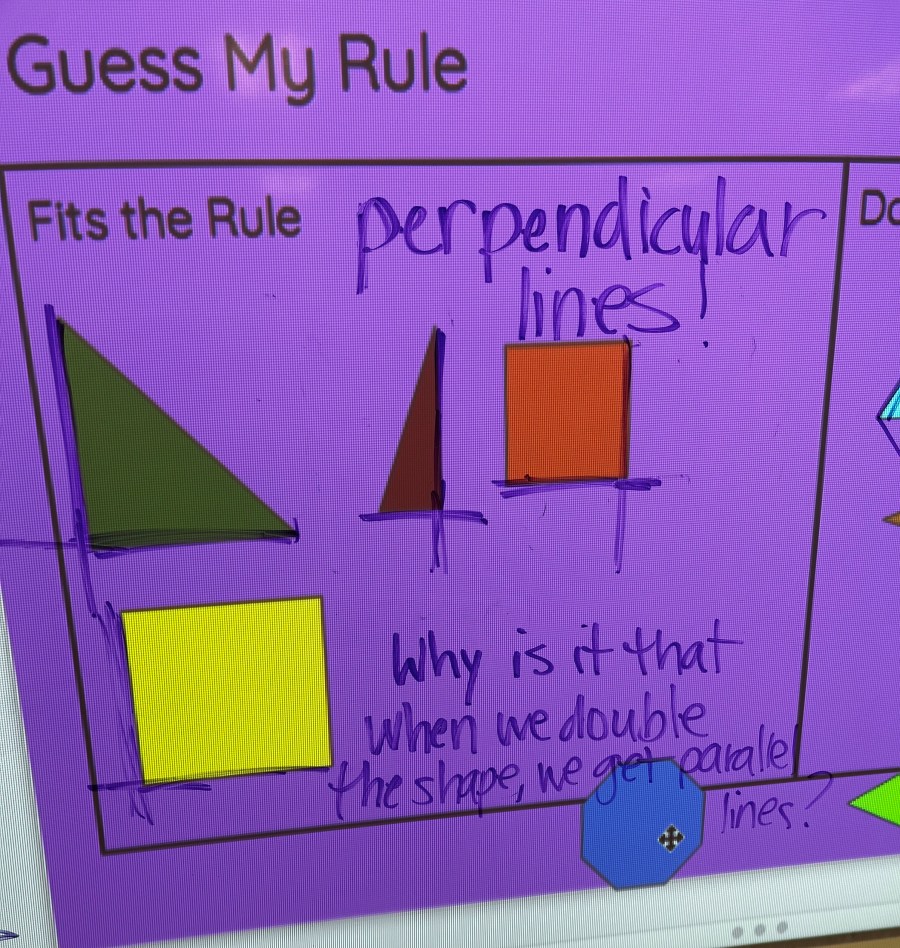
That question runs deep into the properties of triangles and quadrilaterals, and the measure of interior angles.
Within a lesson, or a unit, students develop precise language that helps them not only express ideas, but generate ideas. Priya might not have formulated that brilliant question if she didn’t know that parallel and perpendicular lines within a shape can be important attributes, and, in fact, help us classify shapes and situations. We develop more precise ideas not just over the course of a year, but in mathematical progressions that run across years. I would love to hear our 7th graders respond to Priya’s inquiry about why we end up with parallel lines when we double triangles and quadrilaterals.
Discover more from Jenna Laib
Subscribe to get the latest posts sent to your email.


Ooh, Geometry students could revisit Priya’s question again in high school and formally use properties of transformations in their reasoning (and 8th graders and younger could informally!)
LikeLiked by 1 person
Absolutely! I was initially thinking of all the work with angle relationships and triangles in 7th grade, but the rigid transformation work in 8th grade would be helpful, too! And high school geometers would be able to craft a beautiful argument. You know those standards well. 🙂
I think the fourth graders thought I was joking when I mentioned that we were getting into some high school ideas! Little do they know…
LikeLike