
“Don’t you love New York in the fall? It makes me want to buy school supplies. I would send you a bouquet of newly sharpened pencils if I knew your name and address.”
– Nora Ephron, “You’ve Got Mail”
Ahhh, the start of a new school year. Even teachers who acutely dread the end of summer can usually find joy in the early days of school: crisp, new dry erase markers. Meticulously arranged (and graffiti-free) furniture. The start of relationships with a whole new group of students.
For me, it’s getting to see and hear fresh student thinking about math. Students enter our classes with ideas — lots of ideas! Fully formed ones! Partially developed ones! Previous experiences of all kinds! And it’s what we figuring out how to use those ideas to further mathematical learning and knowledge that I look forward to — even more than I look forward to cracking open a package of expo markers.
Invite, Celebrate, and Develop
I often return to Dan Meyer’s description of our work as math educators: we invite, celebrate, and develop student mathematical thinking. All three of these verbs work in tandem, each one enriching the others. It’s not enough to work solely on developing student thinking and fluency, steamrolling over what students are bringing into class. Similarly, it’s not enough to invite students to share their thinking — marvel at their brilliance! — only to stop there. We need to push students forward. Yes, they’ve demonstrated some great ideas. And we continue the work.
“Yes, and…” is a classic principle of improv comedy, used to develop a scene. In improv, actors offer spontaneous contributions to build the scenario collaboratively, sometimes with different ideas about where to direct the energy. They can disagree, but “yes, and…” maintains the flow of the scene. From there, the scene partners can build what happens together. It’s collaborative and generative — two words that describe some of my favorite math classrooms.
27 x 141
I walked around the desk, ducking between rows, as sixth grade students worked on four problems about multiplication as a warm-up before launching into our geometry work. It was the third day of class.

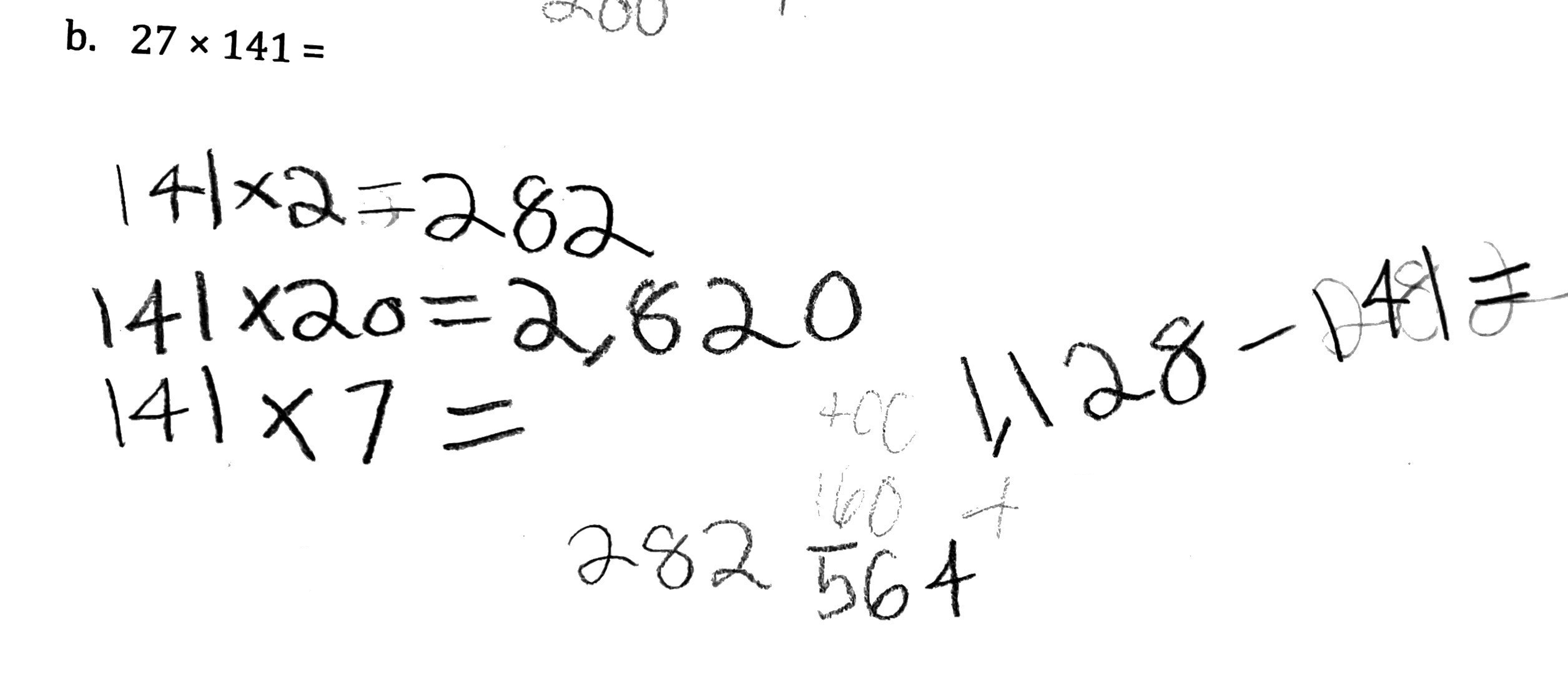
Several students quickly wrote out the US standard algorithm, numbers neatly marching down the page. Sawyer drew careful area diagrams and summed the partial products. Eliza wrote the following:
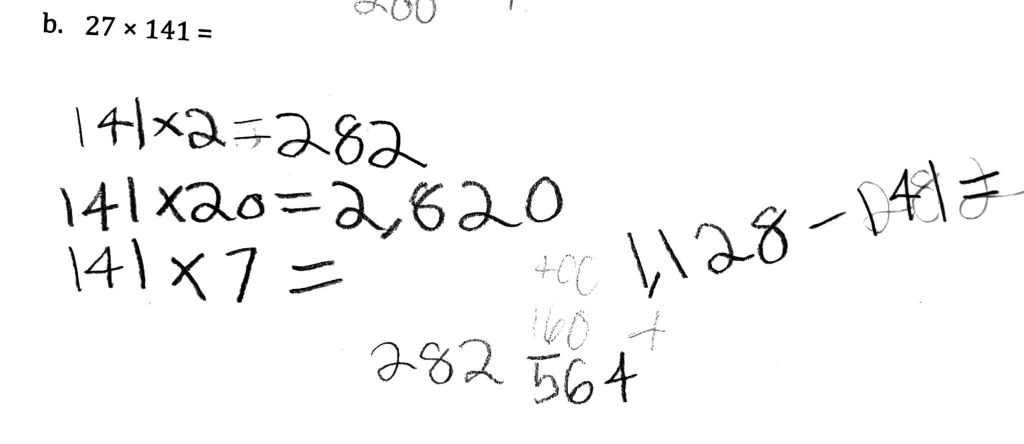
I peered over Eliza’s shoulder. She had decomposed 27 into two parts: 20 and 7. From there, she had multiplied each by 141.
To calculate 141 x 20, she had started with 141 x 2: a simple case of doubling. 141 x 20 is ten times larger, with a product of 2,820.
Then she had to do 141 x 7. At first, it looks at first like the trail has gone cold. On the right side of the equation sign lies a large and empty expanse. A mathematical abyss.

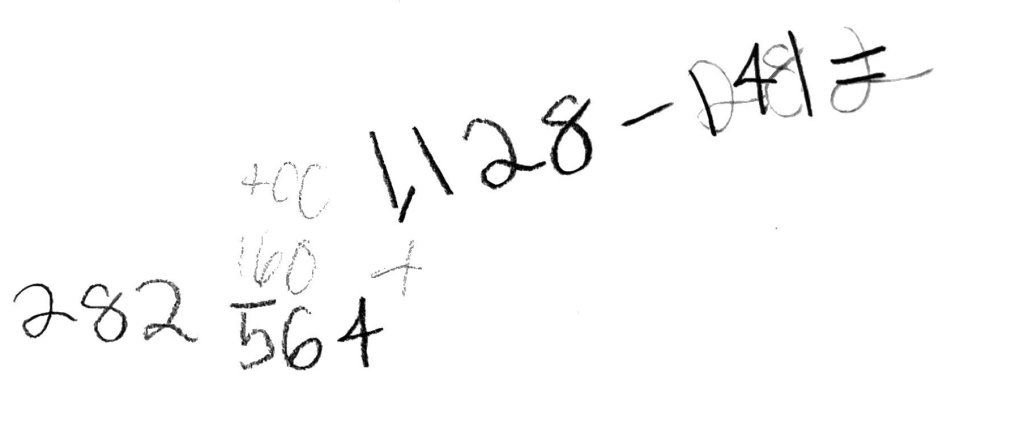
But Eliza wasn’t lost at all. She had scrawled some notes to herself:
282.
564.
1,128 – 141 =
Eliza’s Doubling Strategy
141 is easy to double. There’s no grouping necessary: 1 hundred becomes 2 hundreds, 4 tens becomes 8 tens, and 1 becomes 2. 141 doubled is 282.
To calculate 141 x 7, she continued to use her doubling strategy.
Two groups of 141 is 282.
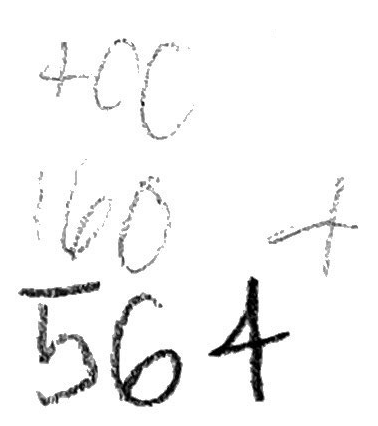
Four groups of 141 is twice as large. Doubling 282 results in 564. There are actually some scratch marks indicating that she broke 282 into place values to double. 200 doubled is 400, and 80 doubled is 160. 400 + 160 + 4 = 564.
From there, Eliza doubled four groups of 141 (564) to calculate eight groups of 141 (1,128).
However, eight groups of 141 is more than she needed. So she started to subtract a group of 141 to arrive at 7 total groups of 141. You can even see where she had initially written 282, but then remembered that 282 represents two groups of 141, and she only needed to remove one group.
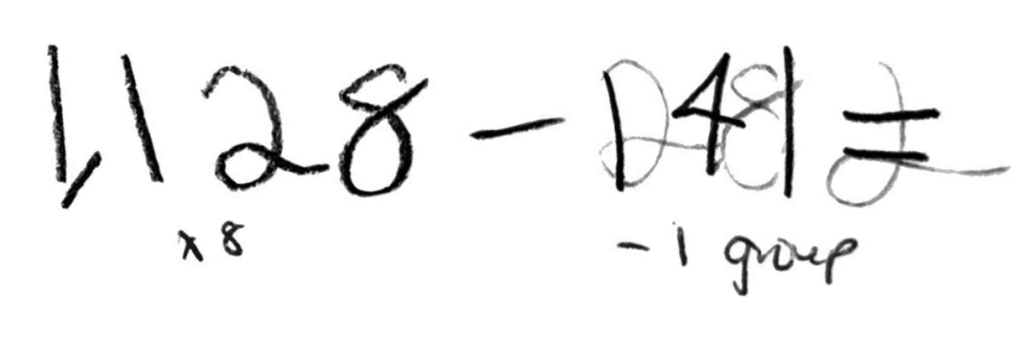
Eliza’s work stopped there.
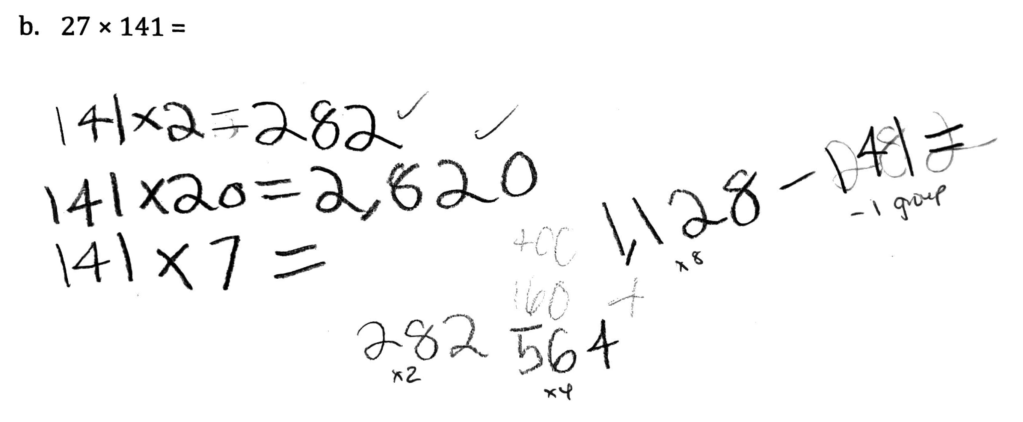
The classroom teacher asked the students to put down their pencils, and began to explain the next activity. Eliza didn’t get a chance to finish.
“Yes!”
Eliza’s work is beautiful! She used proportional reasoning to scale up from one group of 141 to 8 groups of 141, and then back down to 7 groups. This kind of thinking is foundational to understanding and applying the distributive property. It’s the key to unlocking a lot of algebraic work in middle and high school.
It also demonstrates flexibility, a critical component of fluency. She had different strategies for multiplication based on the figures involved.
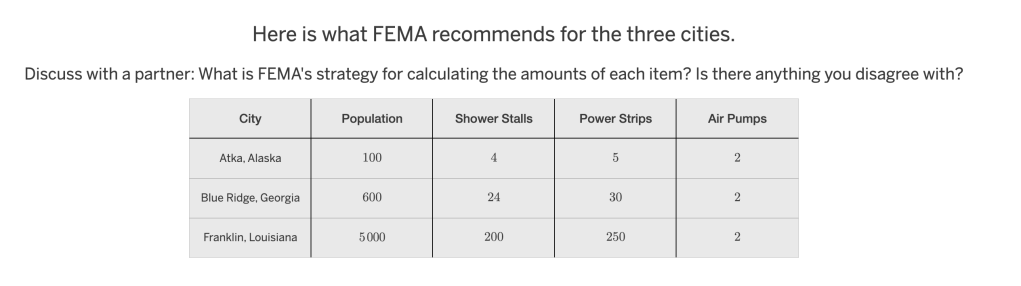
There is so, so much to celebrate in this work. From this work, I see a pathway to build all sorts of ideas about ratios and rates and percentages, which we start in October. Like she’s more than ready to handle things like this:
“And!”
Once we’ve validated her current thinking — and I think of celebration as an enthusiastic validation, that affirms and assigns competence to the student — then it’s time to develop it.
This work is amazing! And!
And Eliza didn’t get a chance to finish, even with her brilliant thinking around dealing with groups of 141. She hit a snag when it came time to subtract. This speaks to both her automaticity with subtraction and also her fluency with multiplication.
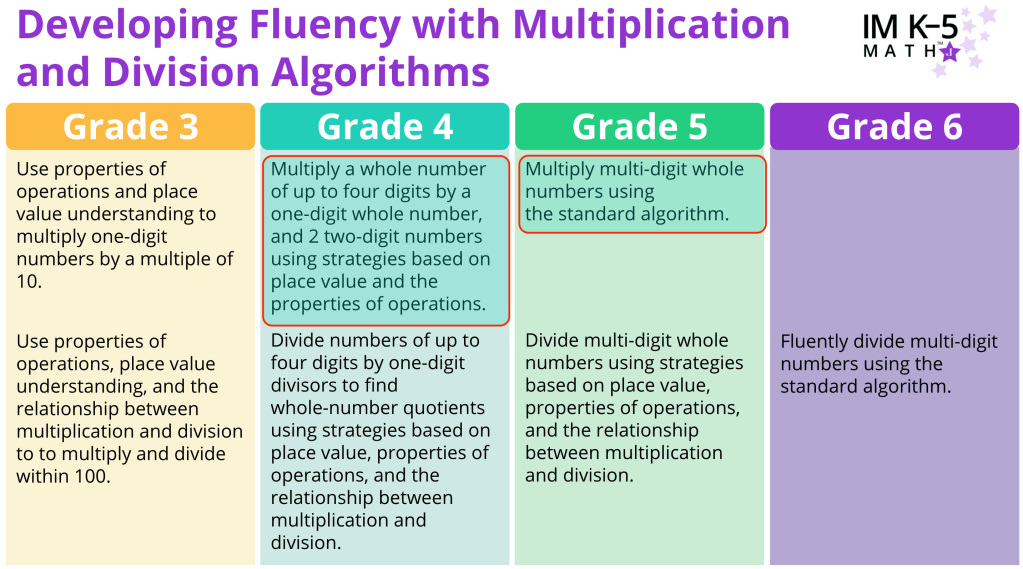
In the Common Core State Standards for Math (CCSS-M), students are expected to develop strong strategies based on properties of operations in grade 4, and multiply multi-digit whole numbers using the standard algorithm in fifth grade. Eliza is in sixth grade.
Is it a problem that Eliza doesn’t seem to know the US standard algorithm for multiplication? She didn’t use it on any of the problems. (Here’s another one from the same assignment.)
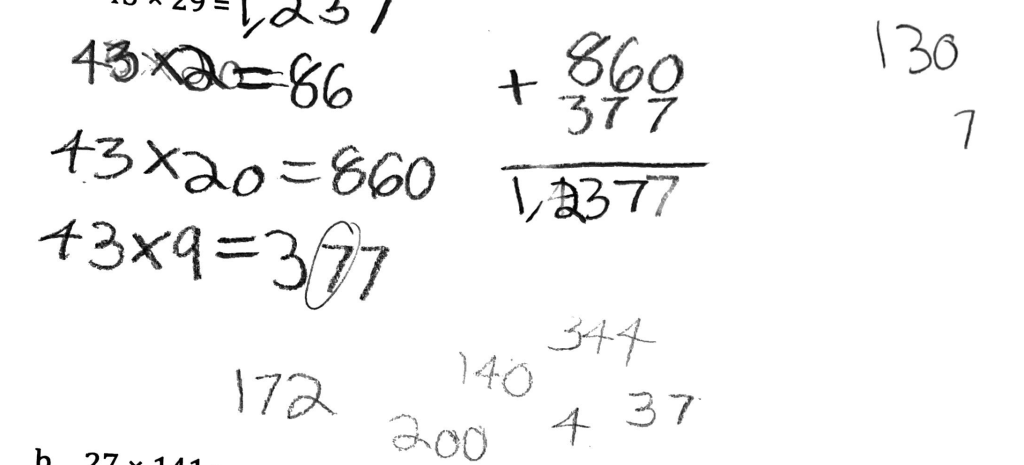
Ultimately, not having an efficient way to multiply multi-digit numbers will impact her accuracy. I am so glad that she’s able to think proportionally! This is an auspicious beginning to sixth grade! AND.
“Yes! And!”
Understanding how to validate (yes!) and how to develop (and!) hinges on a teacher’s content & pedagogical content knowledge. I’m excited about Eliza’s work because I have a learning progression in my head for proportional reasoning. I see areas that I want to help her develop because I know that procedural fluency with multi-digit multiplication is a standard from a previous grade. I worry that, if she encounters a problem about, say, finding the area of triangles that just happens to involve multi-digit multiplication, she will expend all of her energy on the calculation, and thus lose the plot of the problem. It’s a cognitive load dilemma. So where do we go from here? How can we incorporate some work on fluency from previous grades to allow students to focus on new grade level content?
Nathan Minns wrote a blog post illuminating how “Yes, and…” works in improv comedy. He concludes: “as improvisers, we’re constantly thinking about how an idea could work. By continually supporting each other, as a team, we win and create amazing scenes. ” That feels true of my work with students, as well. I think about how their ideas work, and then I support them, as a member of their team, to think about how we can develop something further.
In the meantime, I’m genuinely excited about what I saw in Eliza’s work, and the fact that it’s genuine cannot be overstated. I spoke with Eliza briefly about it before the end of class, and she seemed pleased to hear that this will be a valuable approach in later units in sixth grade. Not only does it work, but it’s sophisticated. And she wants to increase her fluency because she feels stressed when it seems like other kids are faster and know more than she does. (I told her that this perception that other kids know likely does not match reality, but that may not change how it feels inside.)
I look forward to another school year of inviting student math thinking, celebrating and validating it, and using it to move forward.
Edited to Add:
From Jim Orlin:
The other children do know things that Eliza doesn’t know. And Eliza knows things that the other children don’t know. Hopefully Eliza can appreciate that she knows different things in math from other kids and not that she knows less. Moreover, she understands some mathematical concepts that are typically harder to learn. So, in some ways, she has a slight advantage at this point, even if it will take some time for her to appreciate it.
Discover more from Jenna Laib
Subscribe to get the latest posts sent to your email.


The other children do know things that Eliza doesn’t know. And Eliza knows things that the other children don’t know. Hopefully Eliza can appreciate that she knows different things in math from other kids and not that she knows less. Moreover, she understands some mathematical concepts that are typically harder to learn. So, in some ways, she has a slight advantage at this point, even if it will take some time for her to appreciate it.
LikeLiked by 1 person