
When I asked students to think-pair-share, they dutifully respected the independent think time before launching into a buzzy conversation with a partner.
When I asked them to indicate their thinking about an answer, everyone unanimously signaled that, yes, the story problem matched the equation 

As I circulated around the room during some independent work, students were all focused on their work: eyes fixed to the page, pencil perched upright in their hand, and the whisper of pages turning and feet gently tapping against the desk’s legs.
When students struggled to create a diagram to represent their thinking, I suggested they take a “field trip” to visit a friend — Selena, maybe — to conference about their work, and was pleasantly surprised when they returned to create an original diagram that was not a forgery of Selena’s.
Sometimes, teachers ask me whether I thought a lesson “went well.” I confess: I, too, love the adrenaline rush from students being locked in, engagement through the roof. I love when I make a clever connection, or when I offer a smooth-as-butter explanation of an idea, or make a particularly brilliant selection of student thinking to spotlight. I love when students exclaim, “what!” “oh, I never thought of it that way!” Many teachers describe the experience of helping a student to that lightbulb moment as the reason they went into teaching.
And while those are all indicators of a positive classroom experience, and these experiences often correspond with learning, we sometimes use them as a proxy for student learning.
Formative Assessments
There are so many ways to assess student learning during a lesson. I try to get as much input from students as possible while it’s happening: mini whiteboards, hand signals, independent work, collaborative work…
Often, towards the close of a lesson, we have a class discussion. This class discussion amplifies student thinking. It showcases student work. It consolidates ideas. Through this conversation, I aim to clarify any murky ideas or misconceptions that students have. Students should emerge from this clear and explicit conversation with a deeper understanding of the day’s key mathematical ideas and concepts. Done. Stamped!
And here’s why I try not to skip the exit ticket after that.
Grade 3: Naming Parts as Fractions
Third grade students recently began their study of fractions. The other day, the lesson had them working with a partner to fold paper strips to represent different fractions: halves, fourths, eighths, thirds, and sixths.

The trickiest ones for students to create were thirds — how to make them equal size! — and also eighths, which had the students asking how many folds to make. Here, a student tried to fold the paper eight times, each time creating one small part. “I keep making ninths!” She lamented.
Another student showed me his strip folded into tiny sixteenths. “Two folds makes four parts, and then I need four more, so two more folds. But… now I have way more than 8 parts.”
I asked some probing questions, encouraged them to check in with other pairs, and within a few minutes everyone was on the right track. We discussed different folding strategies. We talked about whether these different ways to make eighths both created eighths.
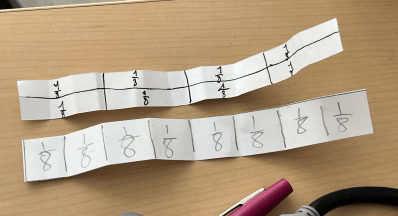
Students worked on paper, too, to partition shapes, and to label shapes that were already partitioned. We gathered on the rug to discuss our findings. Most of the students nodded along dutifully. Adrian, sitting in the corner, used the sharp edge of ruler to carve notches into his pencil. David was cross-legged in the classroom library, beatboxing happily while flipping quickly through books, seeming to skip past every printed word. It seemed like most kids “got it.”
I asked the students to complete a cool down: label each part of a rectangle split into eighths, and then partition and shade the rectangle to show 
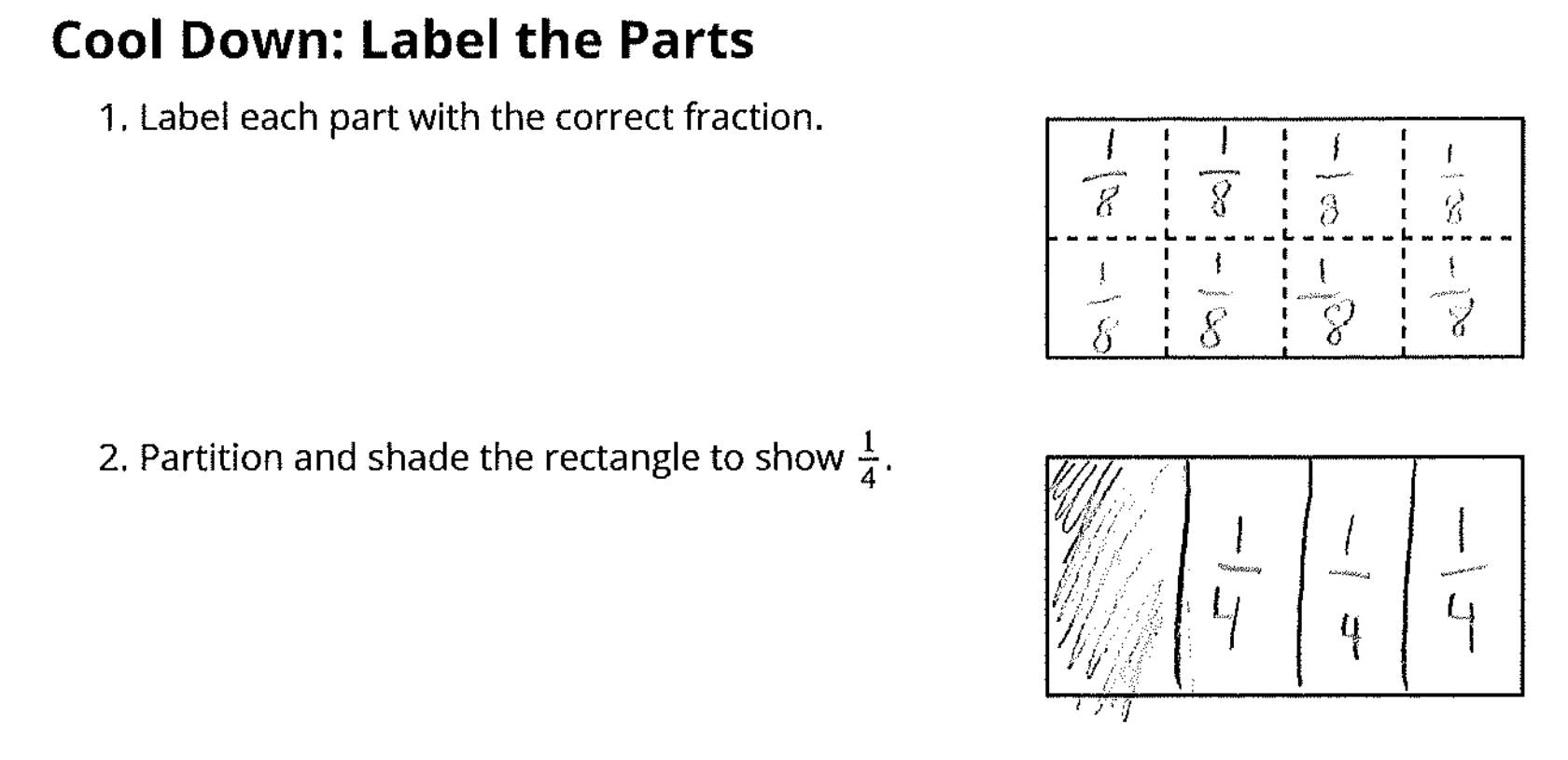
Here’s Adrian‘s work:
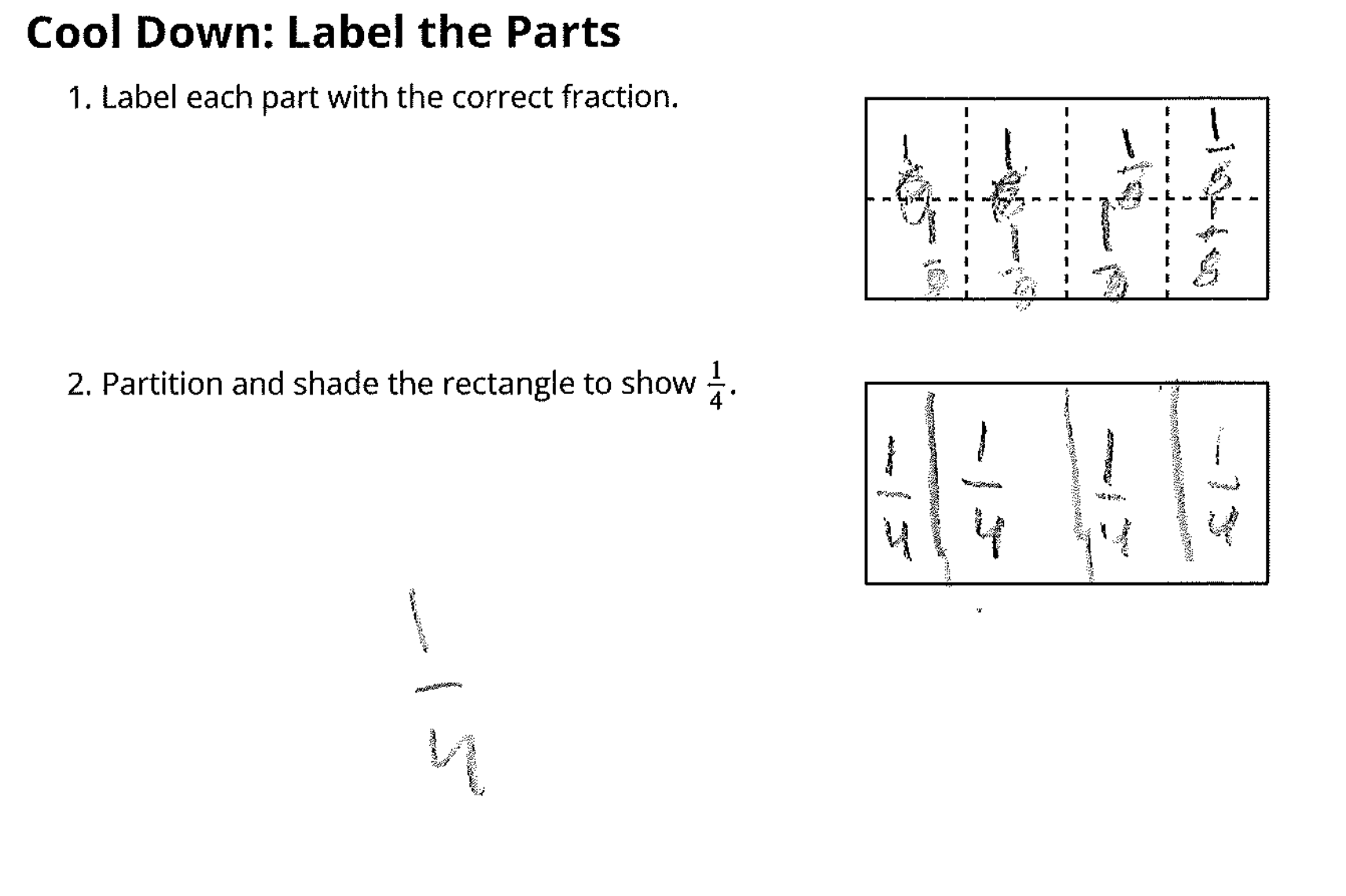
Adrian had not completed all of his work, and some of the work that he did complete showed some basic misconceptions. In his attempt to show thirds, he had created wildly disproportionate pieces. He had made 6 vertical lines to create sixths, but inadvertently created sevenths. I had talked about this with him briefly, only to feel disappointed that he did not appear engaged during the closing discussion. The cool down suggests that he actually did receive the feedback.
And here is David‘s work. It also represented improvement from his class work.
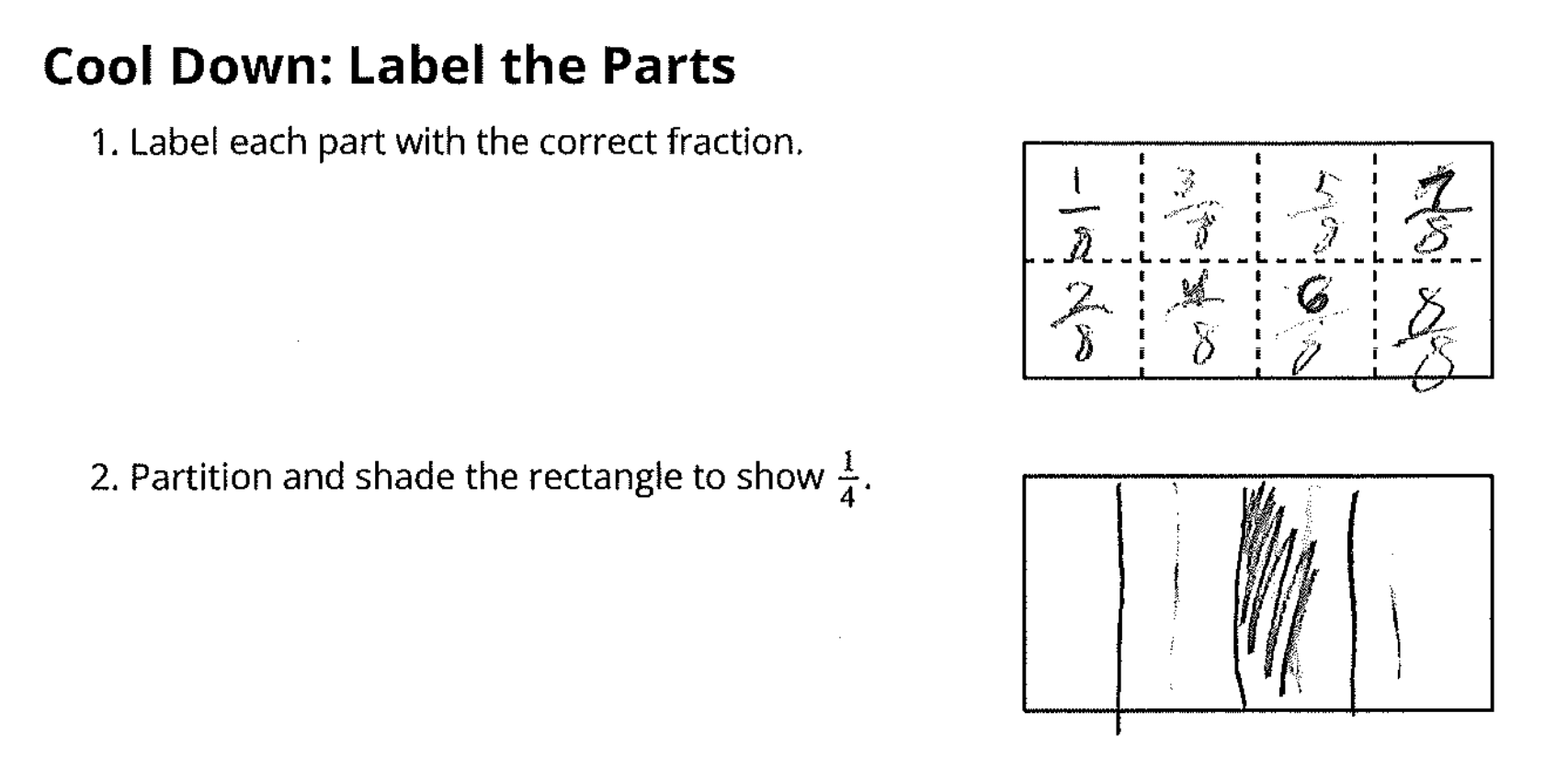
Then there’s Harry. Harry had been fully immersed in the lesson, folding papers with his partner and then labeling things on the page. I had only glanced at his classwork briefly, but he looked to be fully on the right track. But here is his work:
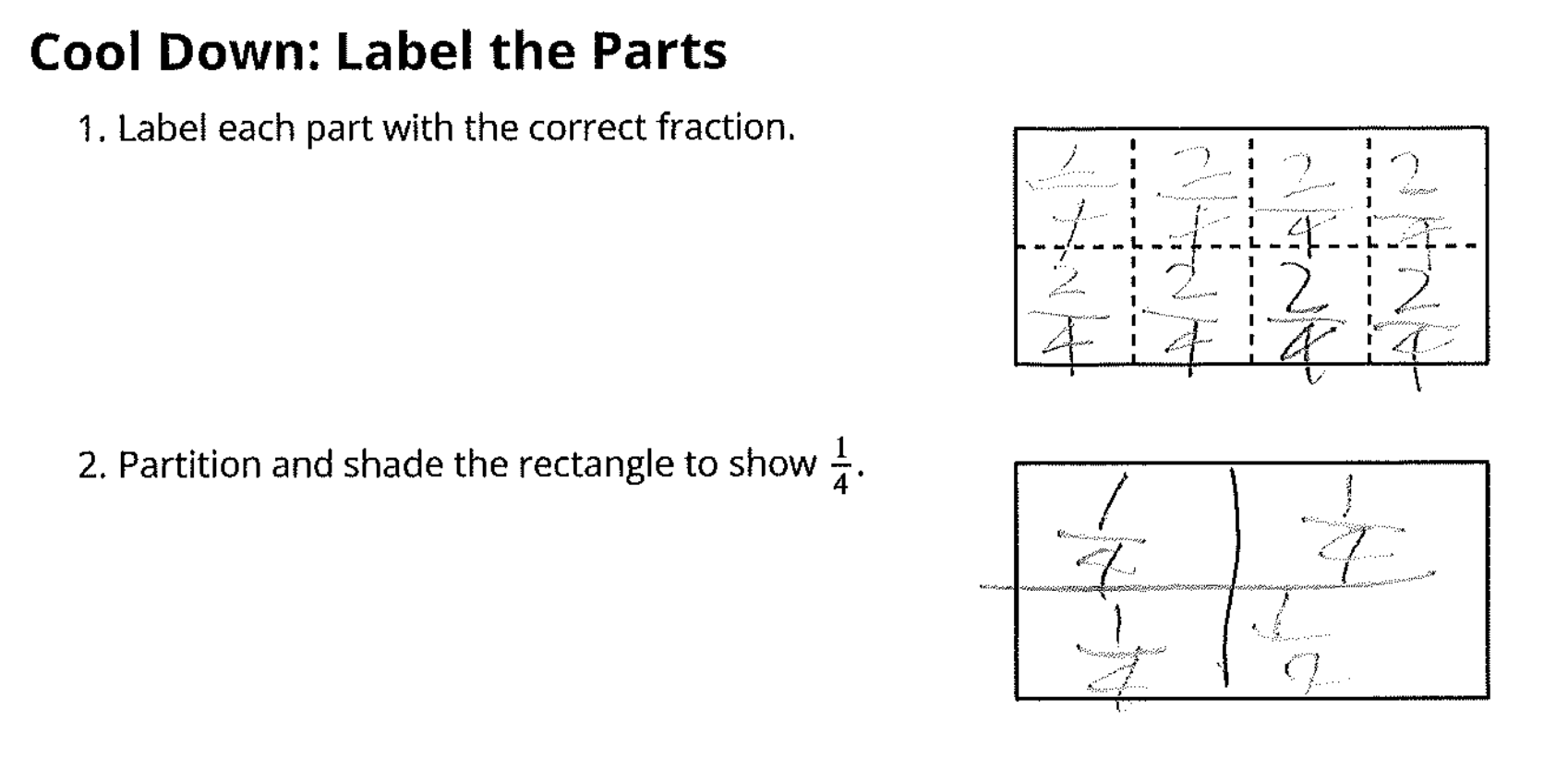
I hadn’t seen any other students make an error like this! He labeled each of the 

It was time for snack, and I had to leave to teach in another room, but I snuck back into third grade an hour or so later. I had a hunch about why he had labeled it that way, and wanted to know if I was on the right track.
“So, Harry, do you remember doing this earlier?”
“Yeah.”
“Can you tell me a little about why you labeled these with two over four?”
Harry paused. He took a sip from his water bottle.
“The fourths are cut in half,” he finally said.
I cocked my head to the right, theory almost confirmed. “Can you show me the fourths?”
Harry traced vertical fourths using his finger. I pressed further: “and then they’re cut in half? Is that why you put the two?”
“Two is for half,” he stated crisply.
True! So he had internalized some of the work of the folding strips, and also the idea that we represent halves with 
“I love that! I see the halves of fourths. How many parts are there in all?”
Harry used his pointer finger to tap each part lightly, mouthing the words as he counted. “One, two, three… Eight.”
I nodded. “Yes, there are eight parts. Tomorrow, we will talk more about why we call those parts eighths, and how to write them.” I wrote
Harry took another sip from his water bottle. “Can I read my book now?”
Using Cool Downs
Really, I could have let it go until the next day. I had an idea of why he had mis-labeled the shapes, and the next day I would make certain to draw explicit attention to that concept.
We usually don’t have time to talk with each kid individually. I didn’t, actually. Harry had the most interesting wrong answer, but here is Ruben‘s work:
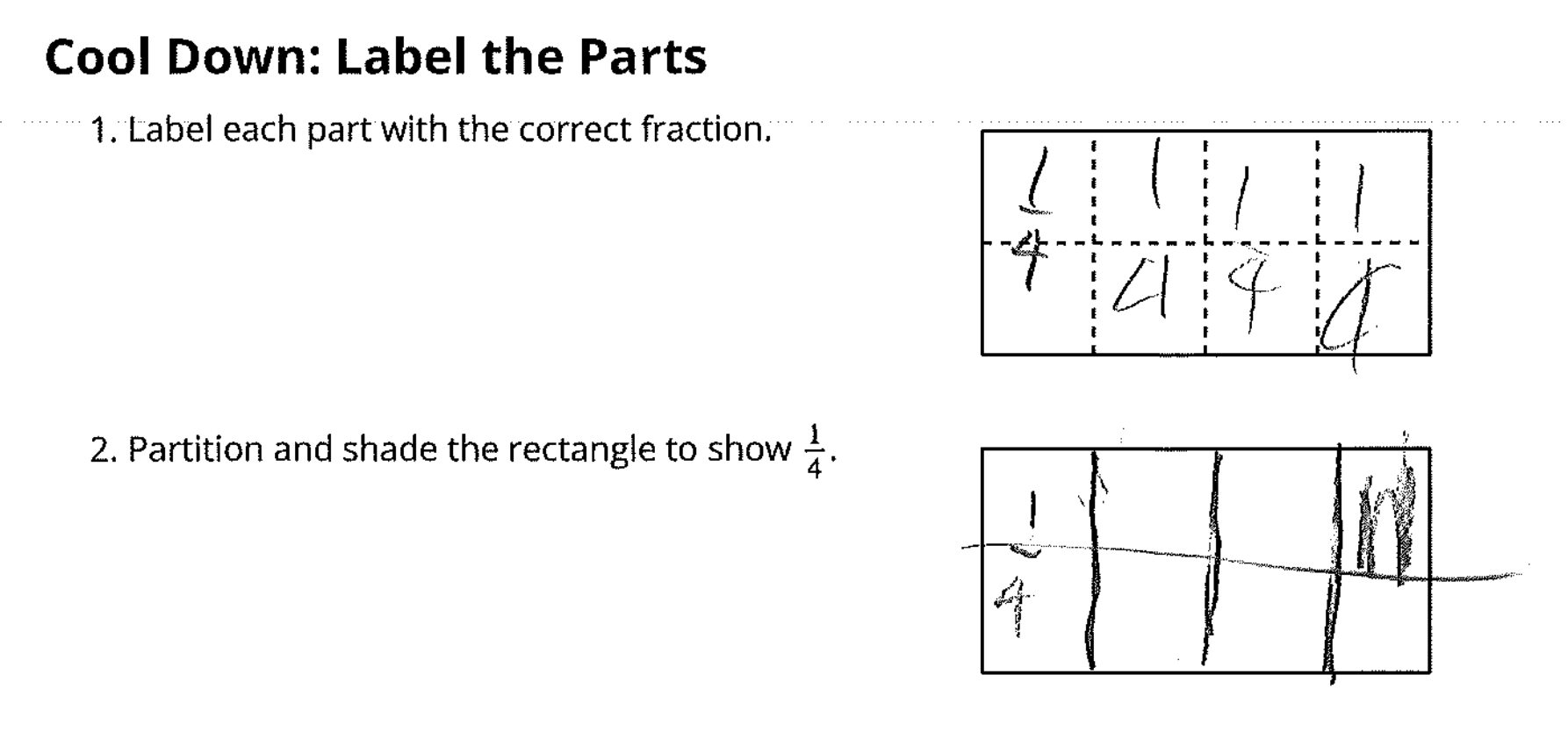
It’s wrong, too. The lessons learned from my conversations with Harry would also likely apply to Ruben, in that I needed to emphasize how 8 equal size parts are called eighths.
The Next Day
The next day, I worked with the third graders again. We launched with a notice and wonder about diagrams broken up neatly into fourths. I recorded the students ideas. As they shared, I emphasized key ideas that I knew students like Harry needed to hear: we have four parts, and those make 
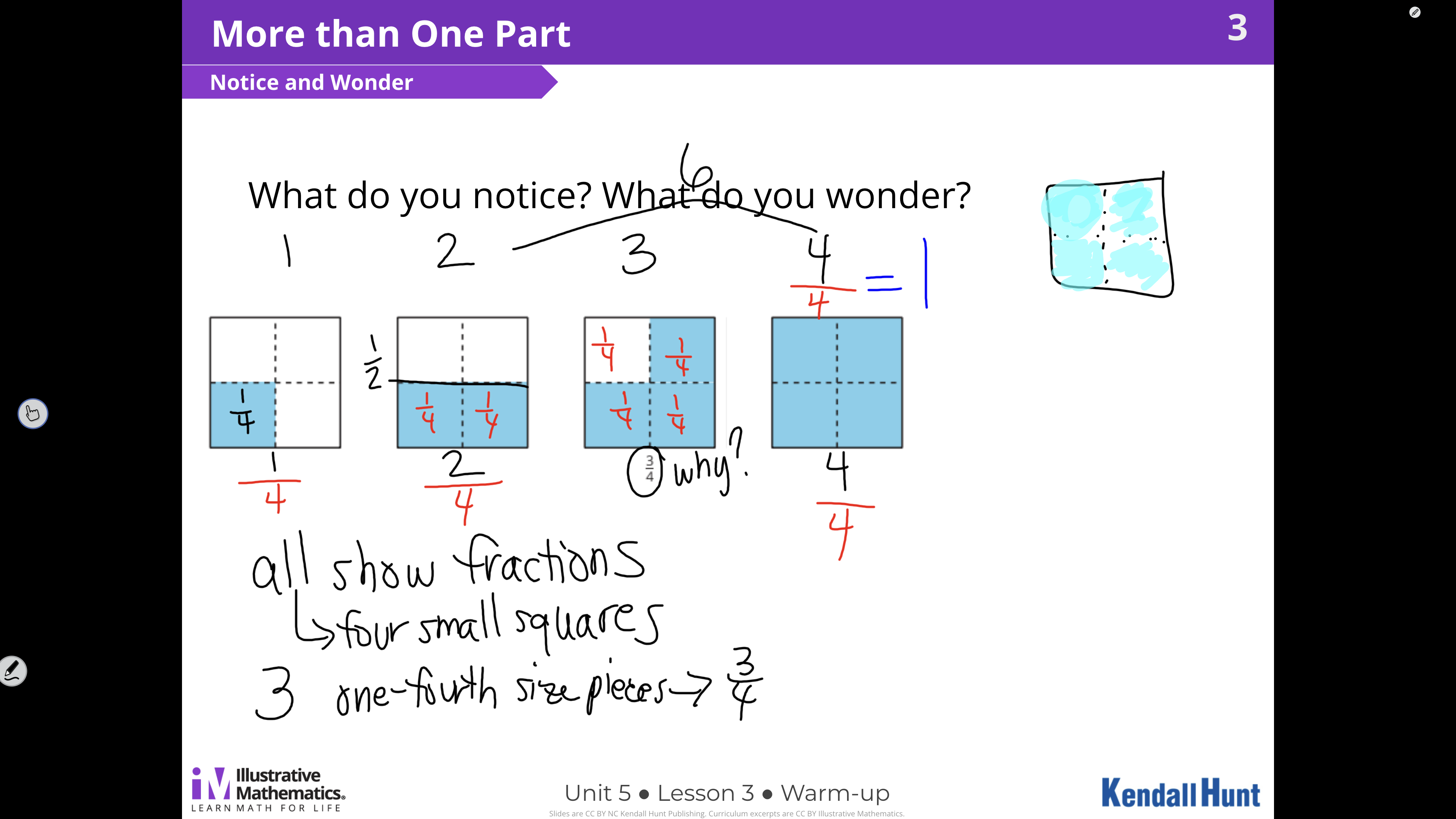
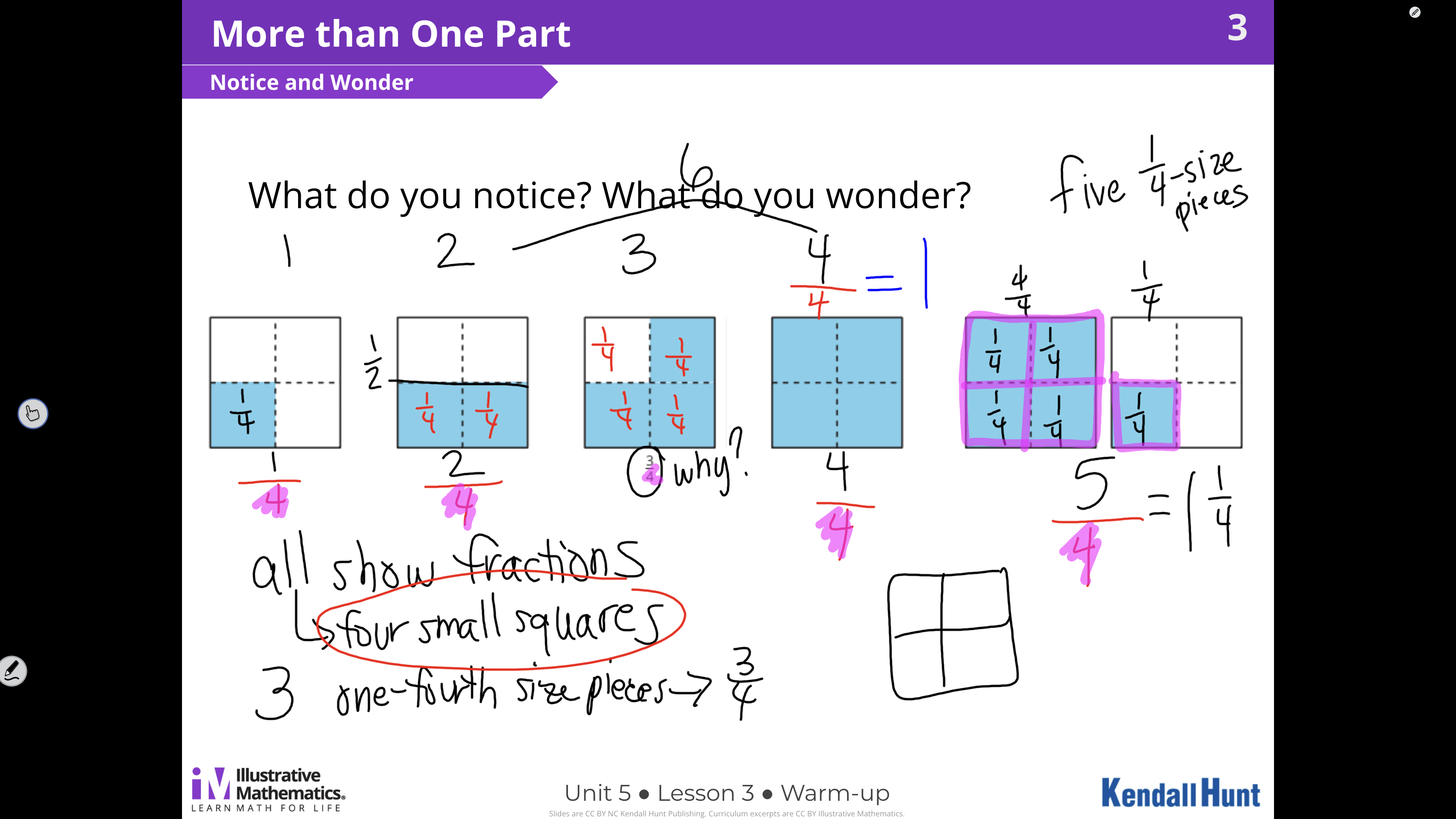
We also looked at fractions greater than 1. Now we have a diagram with five
Later in that lesson, students played “Fraction Match” with a partner, moving fluidly between fraction representations like number form, word form, and shaded diagrams. I took a photo of something I saw Ruben do: match up two-thirds with 
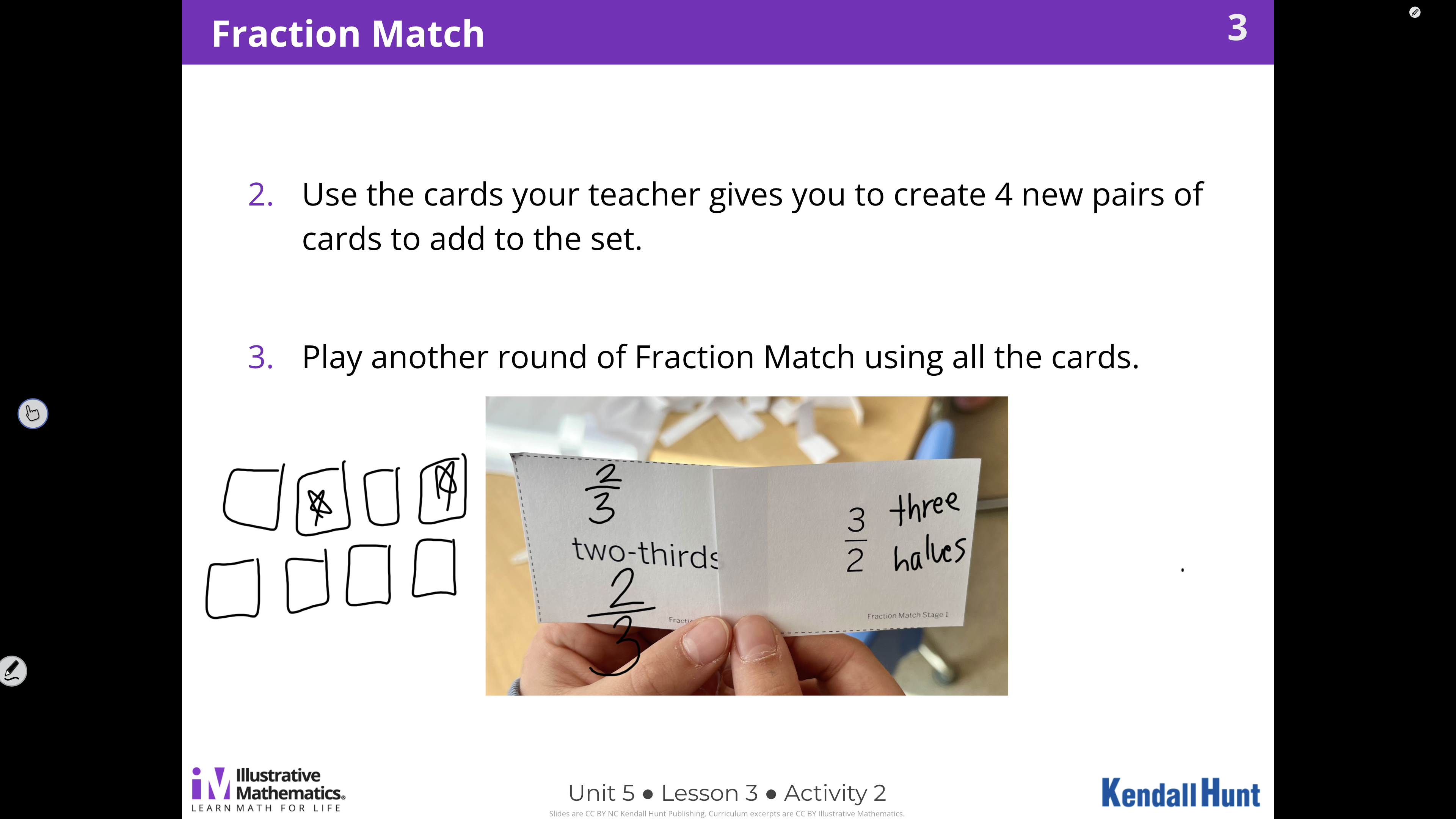
To further belabor the point, we discussed this again during our closing discussion, the “lesson synthesis.”
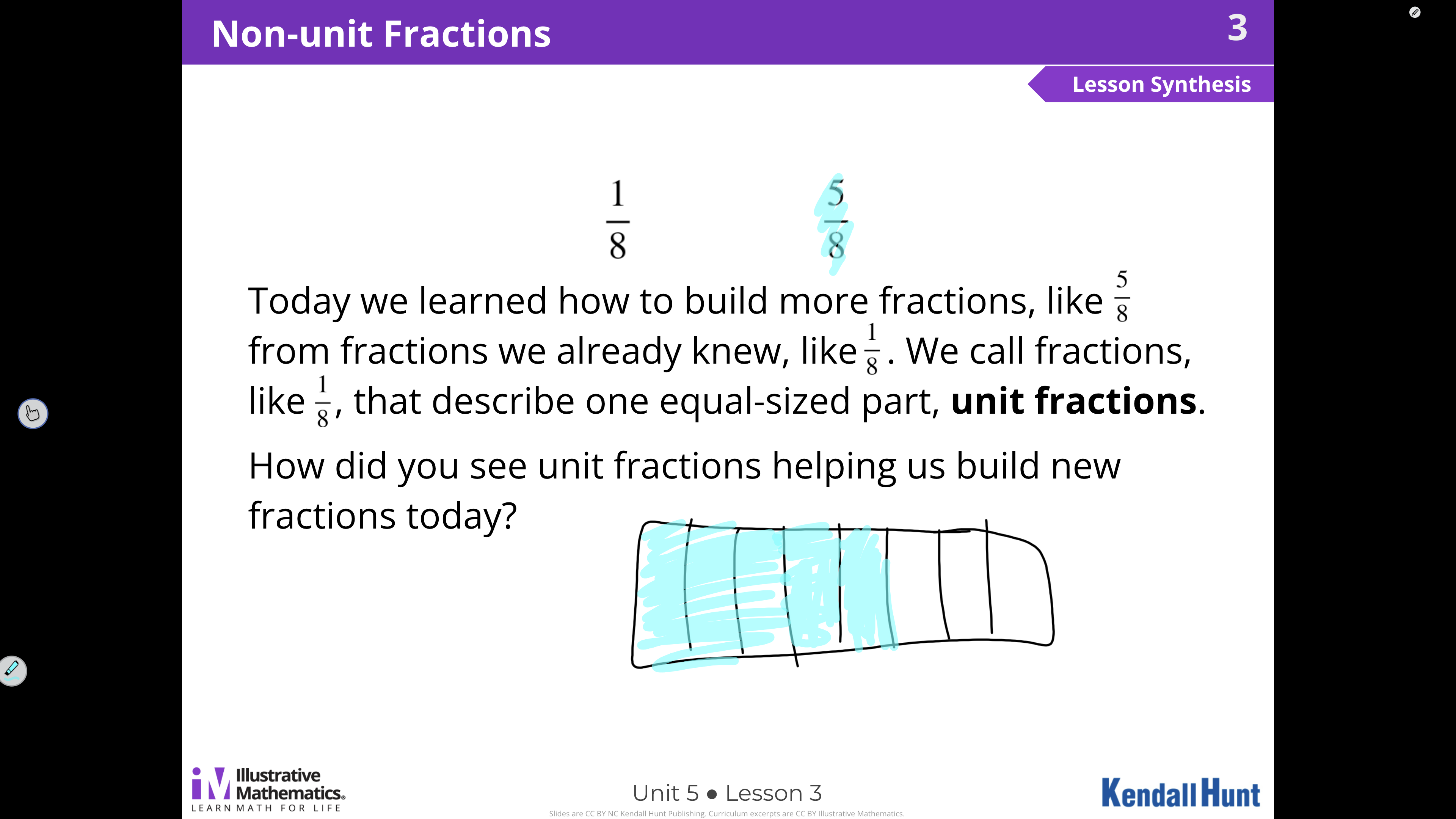
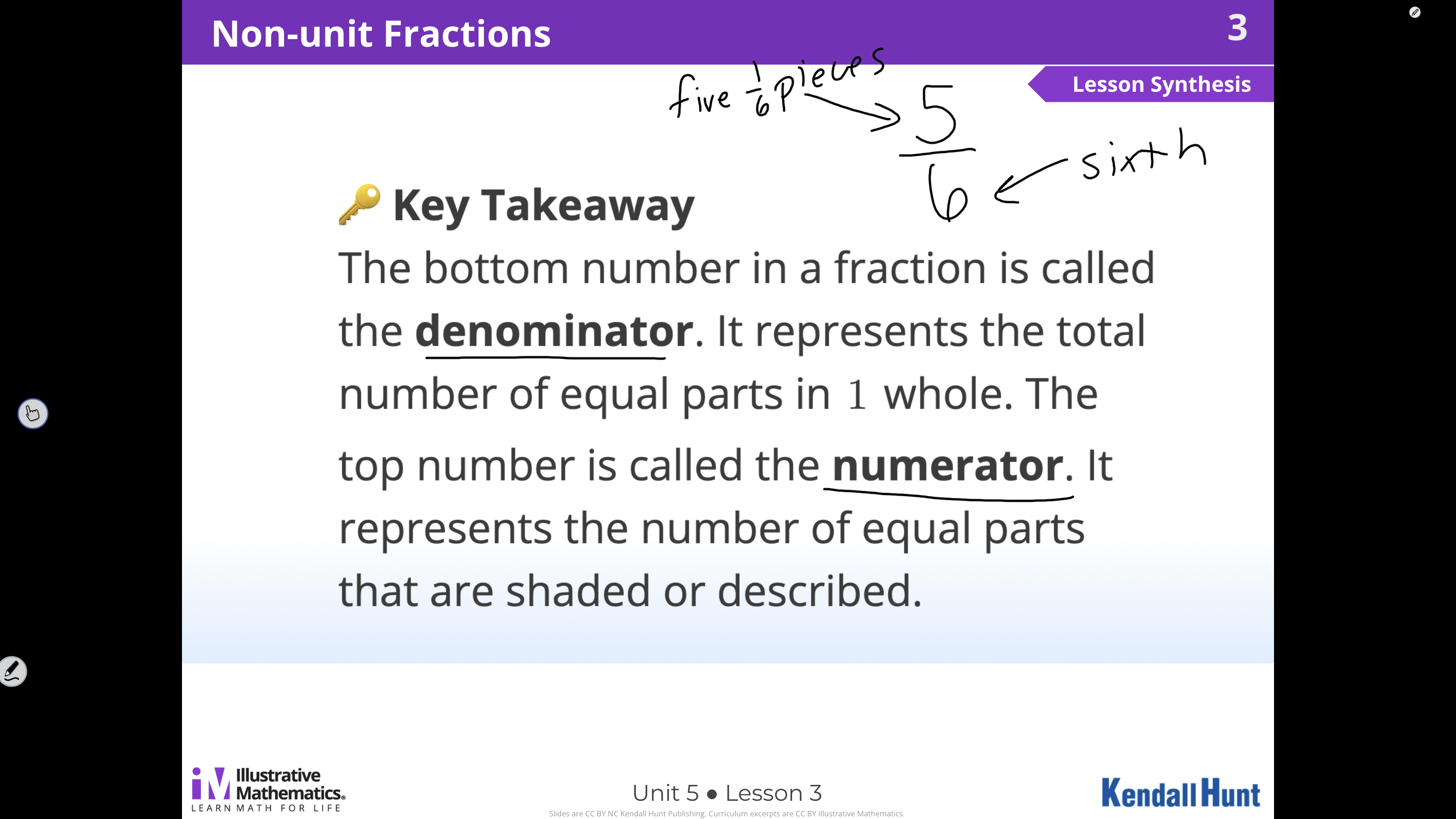
And then? The students had the opportunity to show their learning with another cool down.
Why Use Cool Downs
What I like about cool downs is that they happen after the synthesizing conversation at the end. The students completed this work after I had attempted to clarify ideas. It’s an opportunity for students to showcase their revised thinking. Learning is all about revising our thinking!
For many students, the conversation did what I hoped it would. Their cool downs were clean and accurate.
And for others? They still got it wrong.
I don’t panic. This assessment is formative, after all. I think about how I can use the information I learned about students the next day.
Here’s what Harry did the next day, by the way. He showed me how the first diagram represents 
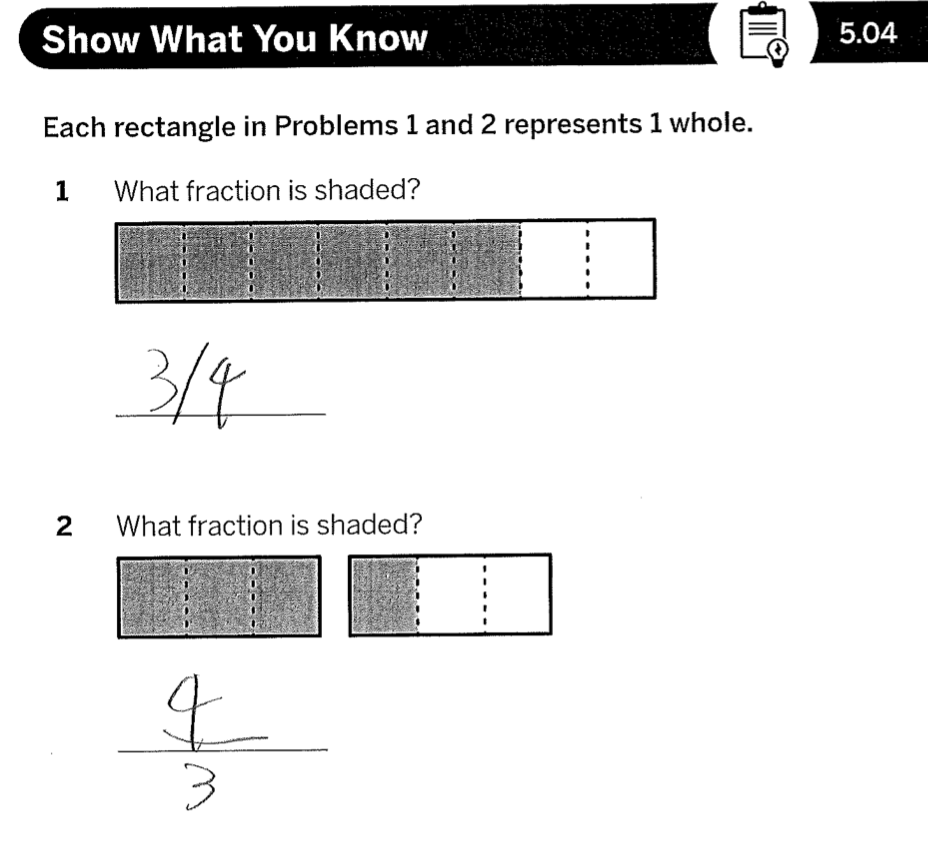
You can see that Amplify Desmos Math calls this formative assessment technique a “show what you know.” The terminology matters less than the practice, although I like what “cool down” and “show what you know” are both trying to get across: that this is not a big deal, just a way for the teacher to get more information.
Here is David’s work from the second day:
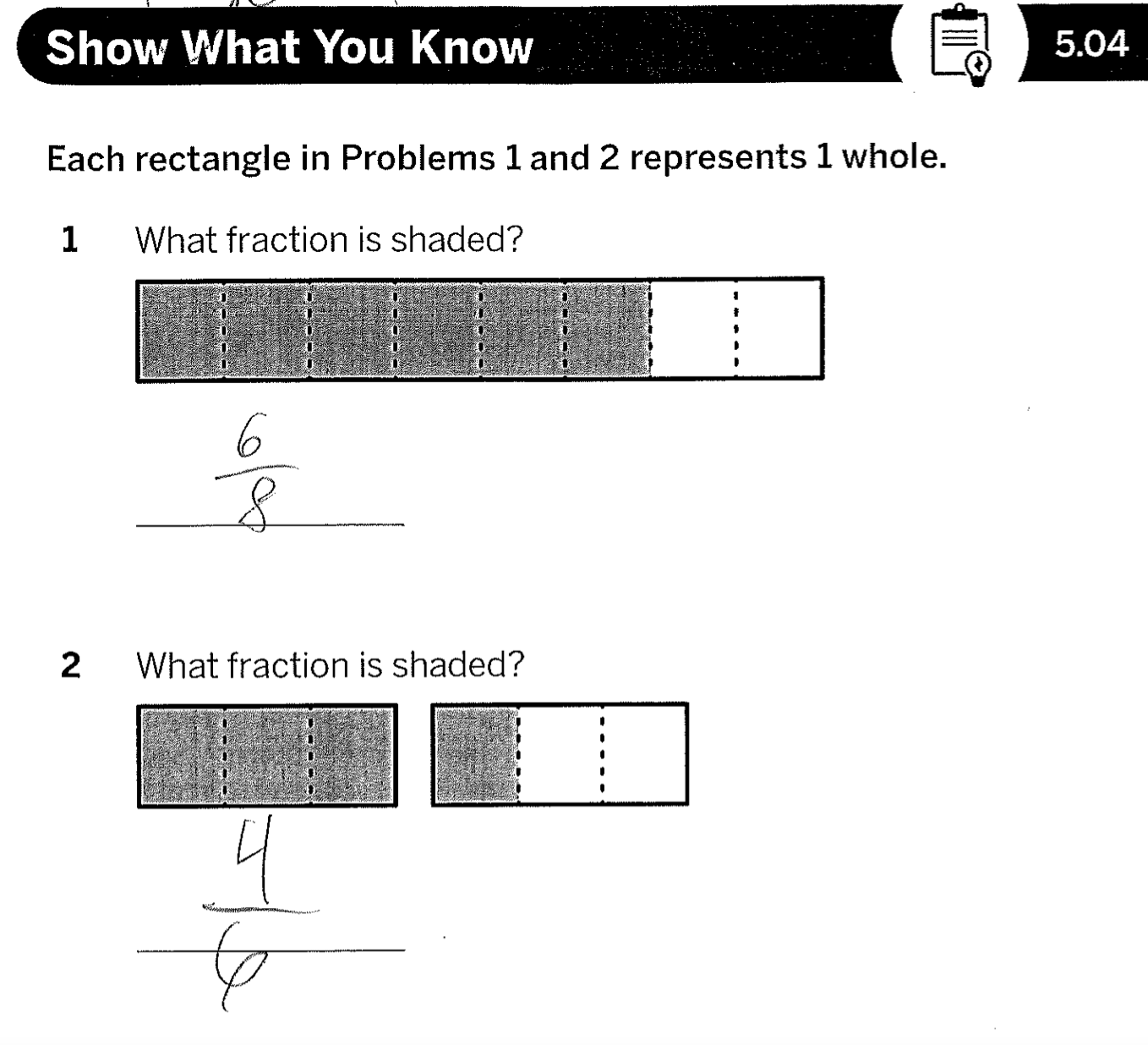
David’s engagement seemed stronger on the second day — he enjoyed playing the Fraction Match game with his partner — but his work revealed that he was still mixing up the size of the parts. Good vibes, but not yet solid understanding. The classroom teacher and I would address it again the next day.
Good vibes matter: they make math class a place kids want to be. More learning can happen in those spaces. But we can’t stop at vibes. These short, low-stakes formative assessments let us see past the surface. We can distinguish who is engaged but confused, and who is seemingly disengaged but actually getting it.
Discover more from Jenna Laib
Subscribe to get the latest posts sent to your email.


1 Comment