

During the school year, I spend time thinking about math games for the classroom. Most often, I’m thinking content first. I adapt games with structures I love, like Number Boxes, to highlight different ideas or flex different skills. These games serve many purposes — learn more about student thinking, develop mathematical reasoning and strategies, exercise social skills — but the primary function is curricular. I use them to teach something.
Then summer hits, and I spend more time playing commercial games with my own children. Some of the games are inherently more mathy than others, but we aren’t playing them with a curricular agenda. It’s some fun on a rainy Wednesday!
But even in summer mode, I can’t turn off that mathematical lens. Sometimes, it sneaks into a game with subtlety, through some logic or some spatial task. Sometimes, the game is so fundamentally mathy that it can’t be ignored. As we play, it acts almost like an assessment, letting me know how my kids are thinking about the mathematical underpinnings of the game. I don’t view that assessment as a moment of judgment so much as it is a moment of opportunity.
Here’s what it looked like while playing Nmbr 9.
How to Play Nmbr 9
A quick disclaimer: sadly, Nmbr 9 is out of print. I apologize in advance for getting you hooked on a game that you can only buy via second hand sites. It’s a great game, though.

The game comes with numbered tiles. The numbers are composed entirely of straight lines, and thus have a futuristic if not straight up dystopian aesthetic. While the pink 8 leans elegantly to the right, the orange 2 feels lopsided and heavy, like it’s trying not to flip over in a boat.
Each player is given two tiles of each number: two 0s, two 1s, two 2s, etc.
There are also 20 cards, two each of the numbers 0 through 9. These cards are shuffled and placed face down.
The goal is to build a multi-layered structure that scores the most points.
To build their structure, a card is turned over to reveal a number. All players take a tile with that number and place it within their structure. Once placed, a tile cannot be moved. There are some constraints:
- Ground Level: Players may put as many tiles on the ground level as they wish, but all newly placed tiles must touch at least one already-placed tile along an edge. Tiles can be rotated but not flipped over.
- Each tile on the ground level is worth 0 points.
- Upper Levels: Tiles may be placed on top of the ground level. These tiles must rest on top of at least two tiles. They can’t hang over empty space or bridge a gap in the level below.
- Tiles forming a layer on top of the ground level have a coefficient of 1, so that a seven tile placed on that level is worth 1 x 7, or 7.
- Tiles forming the next layer, two levels up from the ground, have a coefficient of 2. A seven tile placed on that level is worth 2 x 7, or 14.
- Each subsequent layer increases the coefficient by one. A seven tile placed four levels above the ground, for instance, has a coefficient of 4, and is worth 4 × 7, or 28.
Here is what it looks like, sped up:
Strategy While Building
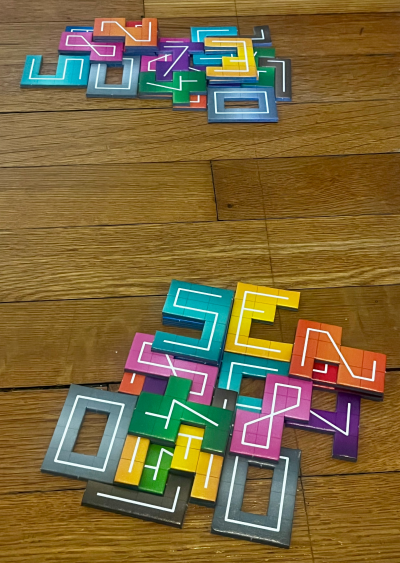
It’s satisfying to watch different pieces interlock, forming a tidy layer of patchwork colors and shapes. As I considered the scoring system, however, I realized that the ground level is a bit of a trap. Every tile placed there has a coefficient of 0, making them worth… absolutely nothing. The most fruitful areas are in the layers built atop that ground level — but those layers require a stable-enough base to support stacks of tiles. A ground level that’s too wide squanders valuable tiles, and a ground level that is too tight leaves nowhere to build.
In earlier rounds, my 10 year old, S, worked hard to form a satisfying grid at her ground level. The four slides neatly into a two, and the long edge of the nine sits flush against a three. It showed a keen spatial awareness. It also meant that too many of her tiles lost all value in the final count.
Meanwhile, I knew that a three tile with a coefficient of 2 scored the same as a six tile with a coefficient of 1. The higher the level, the better! I wanted as many tiles claiming penthouse status as possible. S was frustrated to see that my inelegantly built tower easily beat her tightly composed ranch-style ground level structure in the scoring. She learned quickly: if she wanted to win, she needed to build up, not out.
This foundational understanding of how multiplication operates on numbers dramatically shapes the game play.
Within a few rounds, S was building much faster than I was. She was leveraging what she knew about the shape of each tile: the eights nested nicely on the nines, and a rotated six sat beautifully on a five. There were times when she tried to reserve a spot for a specific number, only to have her hand forced by the randomness of the cards. She might stare at an unfillable hole for several draws of cards, watching her plan quietly fall apart as she waited out the perfect number.
Strategy While Scoring
The game play was fun, but the tabulation of the score is when I started to learn more about how S thinks about multiplication.
I watched her peel off tiles from the layers, making note on paper about the value of each tile. For her two 3 tiles, one was on the level above the ground (coefficient of 1), and one was a level above that (coefficient of 2). She recorded:


S continued until she had a neat column of multiplication expressions.


She had five tiles on Level 1 (3, 4, 7, 8, 9), two tiles on Level 2 (3, 9) and one tile on Level 3 (2). There were 12 tiles on the Ground Level, each worth 0 points.

Then S evaluated each expression, and found the sum. She had each of these multiplication facts quickly, so that was fast. To add the column of numbers, she first looked for pairs of ten and then dealt with odd leftovers, like 9 + 8. She arrived at a final value of 61. Not bad!
In fact, she beat me in that round. I hadn’t been able to push any tile onto Level 3. S was triumphant! She looked at my record of my tiles, however, with curiosity. I had written expressions level by level.


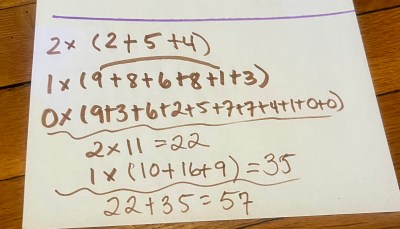
There was some gratuitous work in there — that entire expression for the ground level, for one! — but I wanted to keep things neat and tidy. Parallel.
“You wrote a lot of long sentences.” S observed.
“I did. What do you notice about them?”
She paused for a moment — perhaps triggered by my teacherly tone, or the use of notice, which is one of my favorite teacher words. Then she said, “You have multiplication and also addition, all working together.”
It was a lot for her to look at, visually, and she hadn’t watched me creating the record, which would have made it easier to access. So we played another round.
Strategy While Scoring – Round 2
We played another round, this time building higher, using what S had noticed about the connections between shapes.
When it came time to evaluate our scores, I noticed that S had made a looooong expression.


She then rewrote it without the multiplication, creating a column that she could sum together like a number string.

S had shown how she could use multiplication and addition to find her total score, in a single expression. This represented a step up symbolically from her last work, although with very similar ideas underlying it: multiply each tile by its coefficient, and use the “make a 10” strategy to wrestle with the long column of addends.
And here’s what my record looked like:
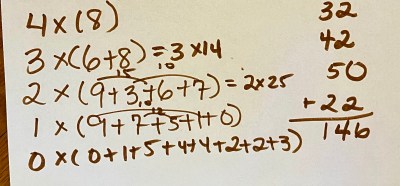
Again, I distributive strategy of finding the sum of each layer and multiplying the sum by the coefficient, rather than multiplying out each tile individually. Because I was dealing with larger sums for each layer, I wrote notes on the side, like how 
This time, S watched me as I recorded my notes.
“Why are you doing 

Does the order matter?
Does it matter whether we multiply each tile and then add the products together, or can we add the tiles and then multiply the sum together?
S and I tried it out with an example.
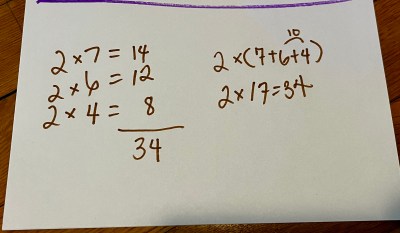
But the fact that it works still feels magical. Does it ever break? What happens if we use fractions, or negative numbers, or subtraction or division?
It’s easier to see the distributive property at work with arrays: decomposed and then recomposed.

I will say that the polypad visual took long enough that S had lost a fair amount of interest. We decided to take a break from the game. Besides, there are so many other good ones that we had nearby! Genius Star. Bandito. It was fine to move on.
What I Learned about S’s Thinking
There can be tension between spatial reasoning & numerical strategy.
Spatial reasoning and numerical strategy can pull in different directions. Initially, S wanted the most aesthetically pleasing design, but swiftly moved towards trying to maximize her score. (By the time I started taking photos to document, she had already made that transition.) It also required her to think about what multiplication does to a number: when multiplying by a number >1, it increases the value. When we multiplied the value of a tile by zero, it became useless to us. I wonder what would happen if we adjusted the coefficients of the levels? Maybe used negative numbers? It’s one thing for a tile to be useless, it’s another one for it to bring the score down.
Fluency with multiplication facts freed up her brain for other thinking.
S was fluent with all of the multiplication facts that came up organically within our game play. (Typically, one factor was 4 or less, but one time we had an epic round where we combined tiles and stacked up to Level 8!) Because she had these facts memorized, we were able to focus on other mathematical ideas and concepts.
Reading someone else’s “math” can be its own skill.
S could read my symbolic records — partially. It can be challenging to read through someone else’s mathematical syntax. When she saw it being generated, step by step, it was easier for her to parse the ideas, and push back against ones that felt new or uncomfortable to her. I also saw how her own symbolic records developed over time, and moved fluidly between multiplicative and additive ideas. S also seemed curious about why I made particular moves. It moved us nicely into our small exploration of the distributive property.
Was it curricular?
S and I didn’t choose to play Nmbr 9 for any particular objective — curricular or socioemotional. It was just fun. And even though I did not enter with a curricular goal for her, I was curious about her mathematical reasoning, and was able to nudge her towards new ideas, like how the distributive property works, or how it can be applied.
It was just one more thing that happens on a rainy Wednesday.
Discover more from Jenna Laib
Subscribe to get the latest posts sent to your email.
 Jenna Laib