
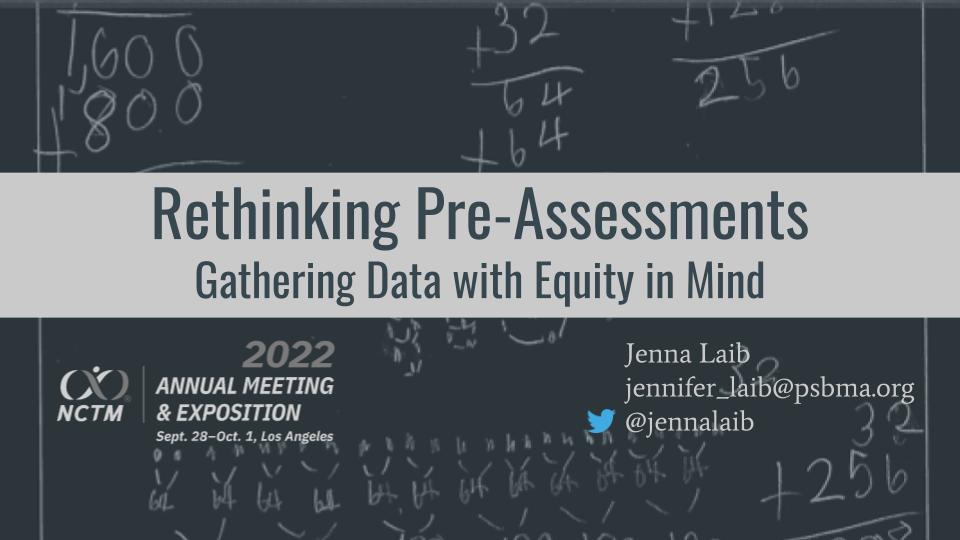
Rethinking Pre-Assessments: Gathering Data with Equity in Mind
NCTM Annual 2022 – Los Angeles #NCTMLA22
Link to Handouts (PDF)
- Link to Handouts (PDF)
- Resources Cited
- Resources for Teaching
- Resources for Planning and Analyzing Student Work
- Additional Resources
Resources Cited
Aguirre, J., Mayfield-Ingram, K., & Martin, D. (2014). The Impact of Identity in K–8 Mathematics Learning and Teaching: Rethinking Equity-Based Practices. Reston, VA: National Council of Teachers of Mathematics.
Bracey, Jamie M. (2013). “The Culture of Learning Environment: Black Student Engagement and Cognition in Math.” The Brilliance of Black Children in Mathematics: Beyond the Numbers Toward New Discourse. Ed. Jacqueline Leonard. Ed. Danny B. Martin. Charlotte, NC: Information Age Publishing, 171-194.
Carpenter, T., Fennema, E., Franke, M., L. Levi, and S. Empson (2014). Children’s Mathematics, Second Edition: Cognitively Guided Instruction. Portsmouth, NH: Heinemann
Guskey, Thomas R. (2018). “Does Pre-assessment Work?” Educational Leadership. Vol 75, No. 5, Pages 52-57.
McCallum, William (2019). “What is Problem Based Instruction?” published on the Illustrative Mathematics blog on February 19, 2019.
https://illustrativemathematics.blog/2019/02/19/what-is-problem-based-instruction/
NCTM (1995). Assessment Standards for School Mathematics. Reston, VA: National Council of Teachers of Mathematics. Accessible here: https://www.nctm.org/Standards-and-Positions/More-NCTM-Standards/Assessment-Standards-(1995)/
NCTM (2014). Principles to Action: Ensuring Mathematical Success for All. Reston, VA: National Council of Teachers of Mathematics.
NCTM (2020). Catalyzing Change in Early Childhood and Elementary Mathematics. Reston, VA: National Council of Teachers of Mathematics.
Lesson Materials (From the Session)
Resources for Teaching
- Graham Fletcher’s Krispy Kreme Me 3 Act Task
- Kyle Pearce’s Donut Delight 3 Act Task
- Chris Hunter’s Arrays & Partial Products (follow up lesson materials)
- Chris Hunter’s Krispy Kreme: Connecting Strategies and Models (to support analysis of student work)
Resources for Planning and Analyzing Student Work
- Full set of student work samples from one class
- Krispy Kreme Data Tracker Google Sheet (names removed)
- Full set of student work samples from follow up lesson (splitting 7×14 arrays, splitting 25×32 arrays)
Additional Resources
Learning Progressions
- Cognitively Guided Instruction books from Heinemann
- Children’s Mathematics
- Young Children’s Mathematics
- Extending Children’s Mathematics: Fractions and Decimals
- Thinking Mathematically
- Graham Fletcher’s Progressions Videos
- New Zealand Numeracy Project
3 Act & Problem-Based Lessons
- Dan Meyer spreadsheet
- Graham Fletcher (K-5)
- Kyle Pearce (3-12)
- Kendra Lomax (K-3)
- Catherine Castillo (K-5)
- Kristen Acosta (K-6)
- Robert Kaplinsky (K-12)
- Jon Orr (6-12)
- Dane Ehlert (3-12)
- Andrew Stadel (4-8)
- Mike Wiernicki (3-8)
- Andrew Gael (K-8)
Clinical Interviews
- Marilyn Burns’ Listening to Learn
- Kendra Lomax’s CGI interview
- New Zealand Numeracy Project
Diagnostic Assessments
- Illustrative Mathematics’ About Diagnostic Assessments
 Jenna Laib