
In February, I gave a webinar for TERC’s Forum for Equity in Elementary Mathematics. I was honored to be invited to speak — it’s an impressive lineup! — and Karen Economopoulos and I conceived of my talk as a direct follow-up to Marilyn Burns’ December session, “Reasoning: The Essential Foundation for Building Students’ Understanding.” Marilyn explored numeracy through the lens of clinical interviews with elementary students; my talk would take up the question of what to do once we’ve learned about student thinking.
The webinar is now available on the TERC website. It’s called “Using Insights About Student Experiences to Shape Classroom Experiences.”

To prepare for the talk, I pored over information that I’ve gathered about students: scanned student work, reports from clinical interviews, etc. There are times when I assess students and have a clear sense of what to do next — and times when I finish an assessment only to slump in my chair, wondering where to go from here. I hoped to speak to teachers who had been there more than once: buried in data, staring at student work, still unsure how to plan for the next day. What do we need to do most urgently… cut through the noise? Organize our thoughts? Procure a stronger cup of coffee?
How do we learn about student reasoning?
There are so many ways that I learn about how students reason mathematically! One of my favorites is: ask them. Within this, there are a wide variety of approaches. Sometimes I use a structured clinical interview, like Marilyn Burns’ Listening to Learn. Sometimes, I confer with students during class. I probe students: how did you know where to start? How did you come up with your answer? Can you convince me that you’re right? On this blog, I write a lot about these direct sources of insight into student thinking.
But there are other approaches that require more inference. Sometimes I’m observing from a distance, or looking at work after class has ended — times when asking the student simply isn’t an option. What do we do then?
For the session, I decided to focus on artifacts of student thinking that require inference, where we lean on our experience with the content and with how students learn it. I used a folder of student work from a third grade class as my anchor.
The Task
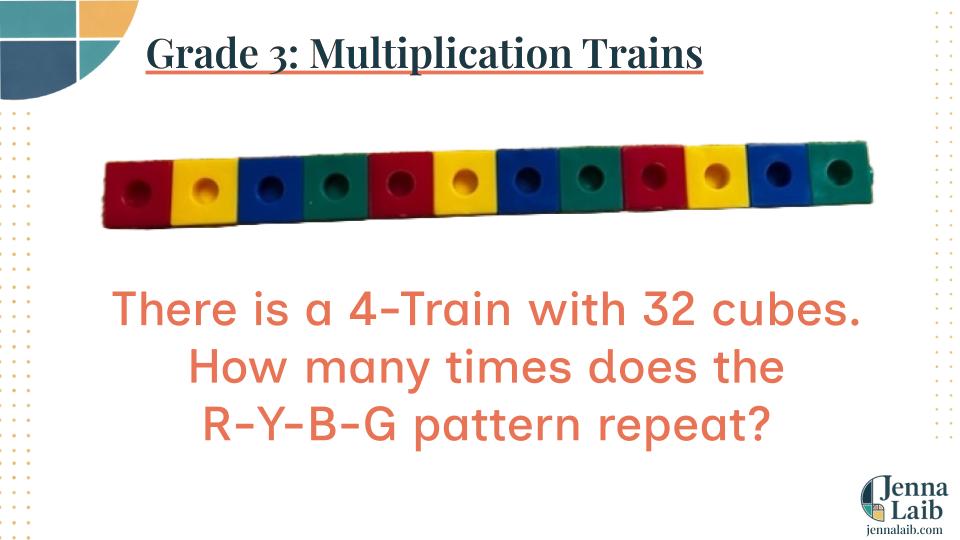
In the fifth unit in Grade 3 of Investigations, the curriculum that my district uses, students explore the idea of multiples using multiplication trains, like the one below.

They follow repeating color patterns. We had asked students questions like, “How many cubes long is the RBG train that has four green cubes? …ten?”
The classroom teacher and I had decided to flip it around a little, and ask a question that elicited some ideas about division. This would give us insight into how students were considering the connection between multiplication and division.
We saw so many different things in the student work! Different diagrams, different equations, different labels, and so on.
It was overwhelming. We could start to classify it: who had an accurate answer? Who demonstrated an understanding of multiplication or division as equal groups? Who used equations? …diagrams? How did they use the diagram?
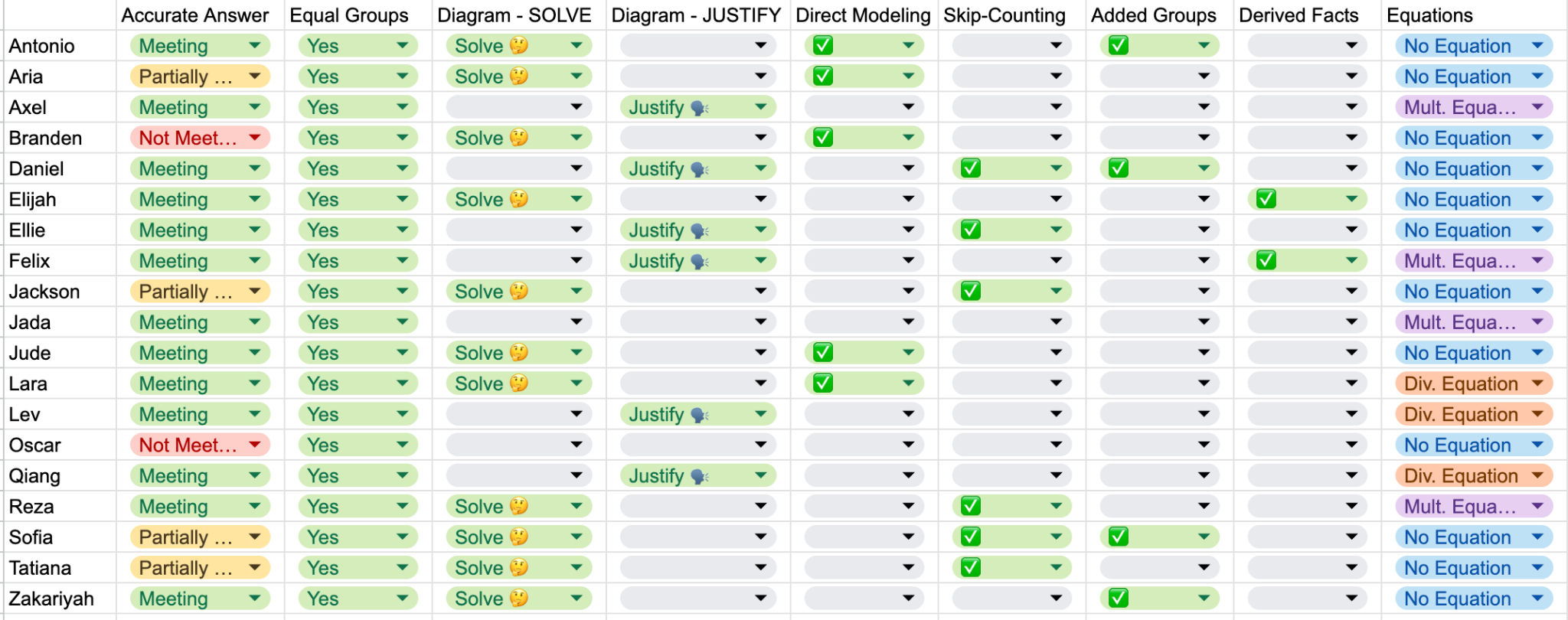
While this gives us a lot of information about the students, it can be paralyzing. Often, I see teachers assume that they need to pull students from one column into a small group to offer targeted instruction. “Oh, this is the skip-counting small group. We’re trying to get them to…”
And so everything splinters. The more detail we extract, the more our attention divides, and we create smaller and smaller bits of instruction. We individualize. This can be a great strategy — I meet with plenty of small groups! — but as a general impulse, it can pull us away from our real work: creating dynamic learning environments where we are all learning together. We sacrifice community.
So how do we balance the individualization of our approaches with the whole class experience?
What, So What, Now What
I thought about how I actually look at student work. I take in the details, then pull back and try to synthesize to see the whole. It’s like adjusting the aperture on a camera, shifting focus from foreground to background. To do that with student work, we need to notice patterns and make some generalizations. (Will this capture every student’s thinking? No, and that’s precisely where some individualization becomes valuable. But when we’re thinking about the communal experience, we need to look broadly.)
I thought back to a protocol that I had used years ago with a Critical Friends Group (CFG). I joined shortly after transitioning from classroom teaching into my current role as a math specialist, and we used the protocol to examine a dilemma, surface feedback, and prepare for action. A cursory web search told me that Terry Borton created the model as a group facilitation technique in the 1970s, before it took on a new life as a reflective tool for healthcare practitioners in the decade to follow, and an educator tool after that. The way it was use in my CFG didn’t quite fit what it is that I do when looking at student work, but I saw the same structure.
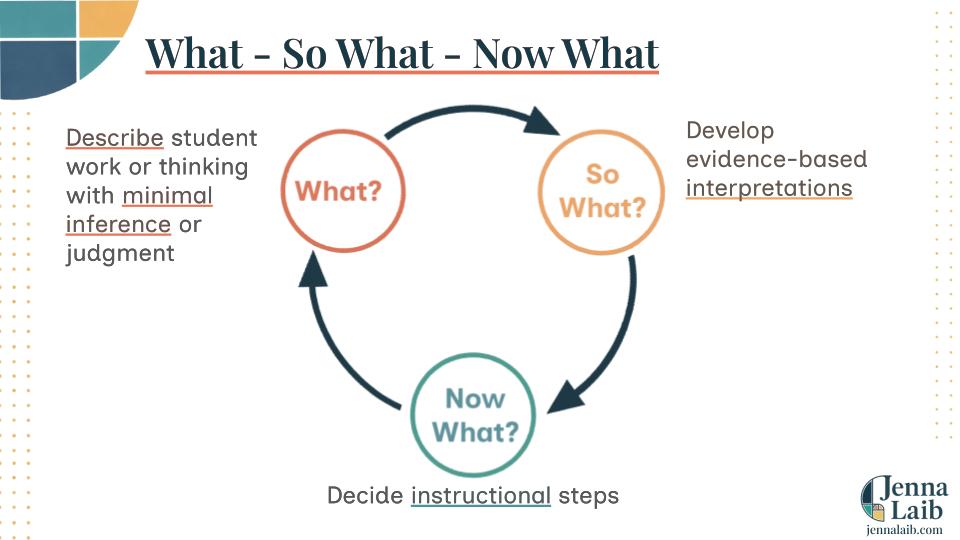
What? Describe student work or thinking with minimal inference or judgment
So What? Develop evidence-based interpretations
Now What? Decide instructional steps
This mirrors some “looking at student work” protocols that I have used with teachers in the past. It’s condensed, but recognizably the same bones. Those protocols are genuinely valuable, and they take time for good reason: developing the muscle of making low-inference observations requires real work and practice. It’s so easy to jump to conclusions! But I wanted to offer something that works on a smaller scale, with fewer steps and layers.
In the webinar, I walked through the protocol with some of the student work samples.
What?
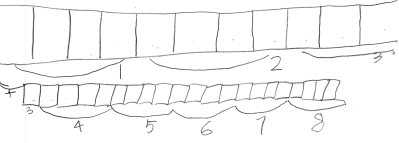
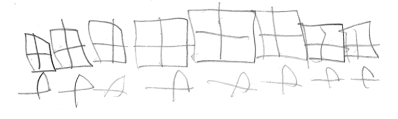
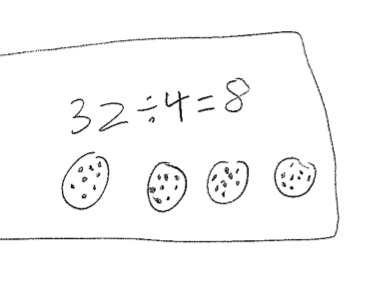
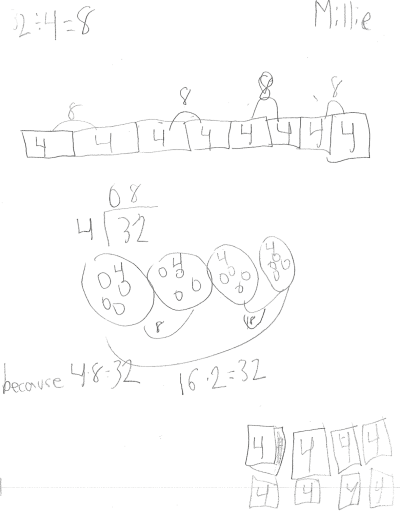
All students showed equal groups in some way. Some used arrays. Some used linear models. Still others used other diagrams, including groups of dots in circles. I noted that some students seemed to use the diagram to help them solve the problem, and others seemed to use it to justify their answer. You can see some of the student work below.
I also noted that most students did not include an equation.
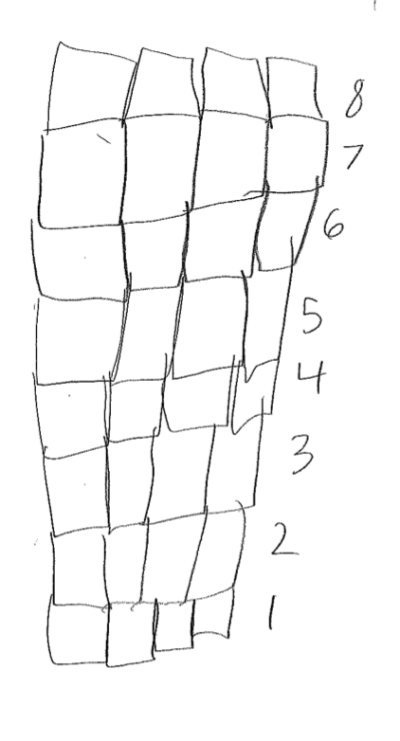
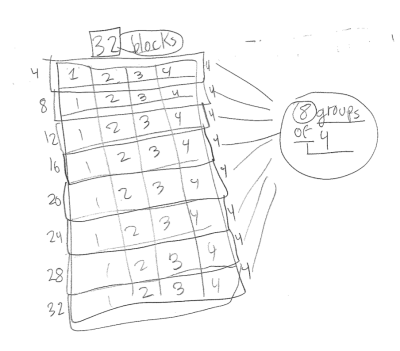
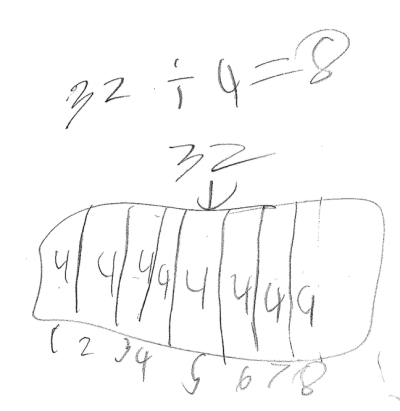
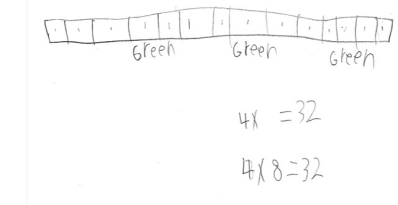
So What?
So what does this tell us?
If students are all showing equal groups, that means many of them are reasoning multiplicatively.
If students are using diagrams in different ways, that tells that diagrams are capable of sense-making at different stages in the process of solving and representing ideas. We can use them to solve and to justify.
Meanwhile, equations were not yet serving as sense-making tools for most students.
Now What?
The next lesson in the curriculum is actually called “Relating Multiplication and Division.” So the students seemed mostly primed for it!
We decided that we wanted to:
- Support students in interpreting division as how many equal-size groups
- Connect diagrams to equations
- Connect multiplication and division
In the webinar, I described how I changed the warm up in the lesson to anchor on a student diagram, and then compare and contrast how it shows different student-generated equations. You’ll have to watch it see how it came together. (To be honest, I haven’t re-watched it yet, in part because all too present in my mind is that, while I was recording it, my 8yo was moaning on the couch “mommmmmmm, are you almost donnnnnnne?” for about 20 minutes. I have been assured that you cannot hear it, so the distraction was mine alone!)
Common Pitfalls
The biggest issue that I see with teachers using a framework like this is that they race too quickly up the ladder of inference (Argyris 1992). It’s important to stay grounded in observations before moving to interpretation. Teachers should describe what they see before stating what they think. Then, we can use evidence to determine “so what?”
The “now what?” can get slippery too. It helps to have a strong repertoire of pedagogical moves, but more than anything, it’s important to stay anchored in the learning goals. What do we want students to understand? …to be able to do? …to explore?
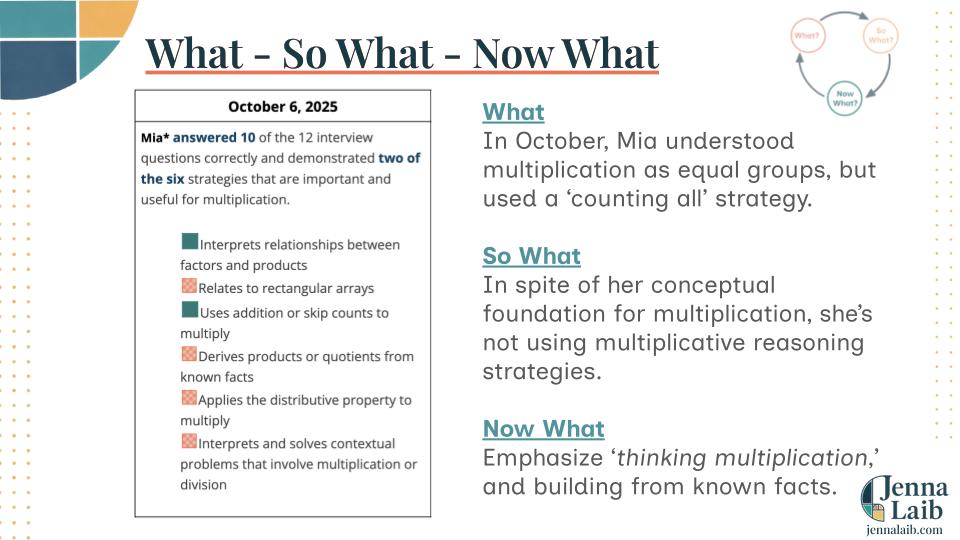
Here is what it might look like briefly for Mia, from my last post about measuring student growth.
Holding On In the Storm
Teaching is a dynamic process, just like learning is. We are constantly thinking, revising, refining. Sometimes I work through a process like this and the lesson lands exactly as I’d hoped. Sometimes it doesn’t. We all have our flops. But the framework isn’t about getting it right every time. It’s about having something to hold onto when the work feels overwhelming.
Discover more from Jenna Laib
Subscribe to get the latest posts sent to your email.
 Jenna Laib