
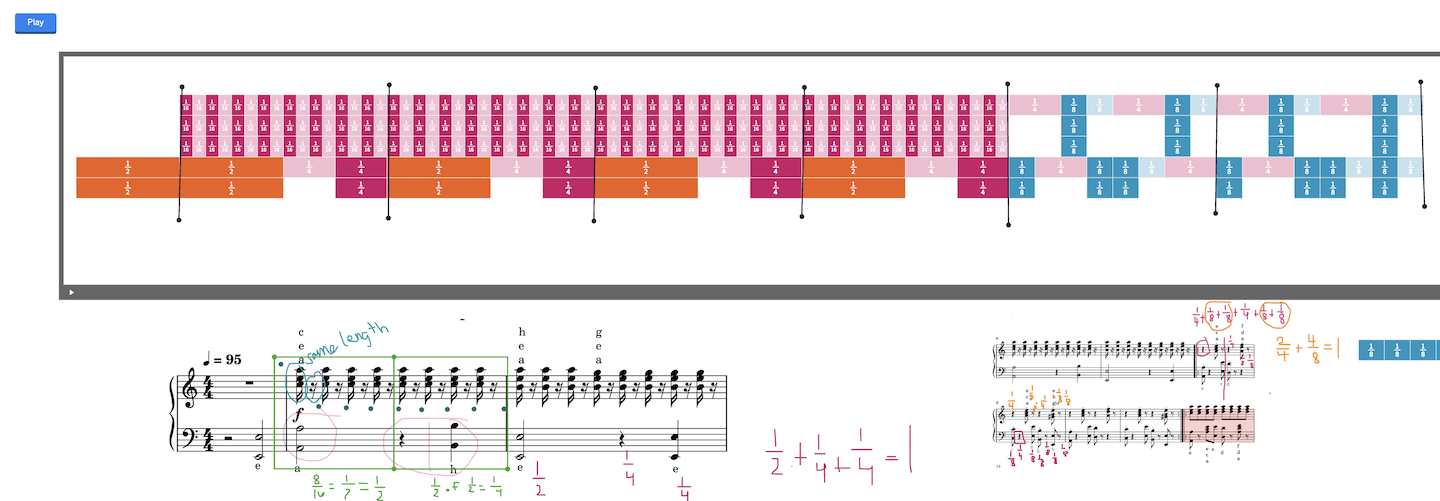
As we waited for others to arrive, Ava couldn’t help gushing about her weekend. Her parents had taken her to Montreal for the weekend to see Olivia Rodrigo in concert.
“It was amaaaaaaazing!“
I smiled as I listened to her, and tucked away the idea that we might do something with this. I meet with this group of seventh graders during what should be their ‘conservatory,’ or music time. They’re missing music class to “fill in gaps” related to fraction concepts and operations. It’s going well — and it’s important work! — but it feels bittersweet to come at the cost of music.
While the kids worked on an assessment task, I quickly looked up simple Olivia Rordrigo sheet music. I couldn’t believe my luck: “Drivers License” started with repeated eighth notes. Lovely!
I – know – we – weren’t – per – fect – but – I’ve
Clap out the rhythm. It’s even. Steady.
The measure has been broken up into equal size parts… like fractions.
Fraction Intervention
These seventh graders are meeting with me to work on fraction concepts and operations. The middle school math teachers and I identified this as a particular need, impacting the students’ ability to access the grade level content. Their current fraction understandings and skills are such that “just in time” interventions — things like number talks and warm-ups designed to activate and strengthen prior learning — will not be enough. So we are spending a few weeks focused on fraction standards from grades 3 through 6, using the Transition to Algebra curriculum that nicely connects elementary concepts to middle school content. Here are two sample problems from the very first lesson in the fraction operations unit, showing how we are not just adding fractions with like denominators, but making generalizations and connecting to ideas like the distributive property, equivalence, and the commutative property of addition.

Topics for the “fraction intervention” include:
- Understanding fractions as being built from unit fractions (e.g.
)
- Naming and identifying equivalent fractions
- Comparing fractions
- Basic operations with fractions
- addition and subtraction
- multiplication and division
Naming Fractions: The Measure as a Whole
I projected this first section of the simplified sheet music to “Driver’s License” on my smartboard.
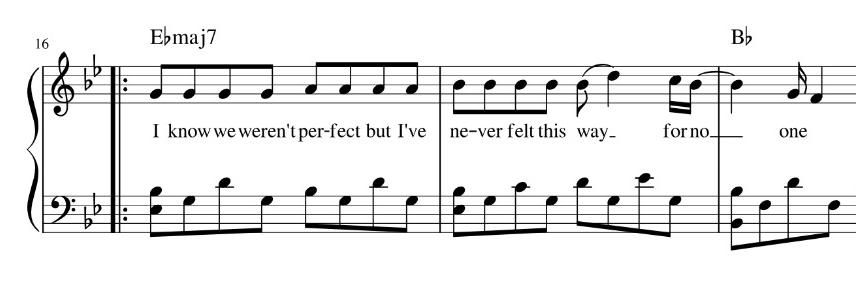
“Okay, so do you see these thick vertical bars? They mark off the measures. Let’s treat each measure like it’s a number line, and a measure is worth 1 whole.” I circled the first measure.
“See how these notes are all the same shape? They are all the same size, or value. Listen to me as I clap it out. They’re all equal. How many of them are there in the first measure?”
Ava came up to the board, and touched each note along its stem. “Eight,” she announced.
“So if the measure is worth 1, what is each note worth?”
“One… eighth?”
“Precisely!” I must have looked like a mad scientist, rushing back to the board, and frantically changing the colors to highlight. I drew examples of eighth notes at the bottom of the screen.
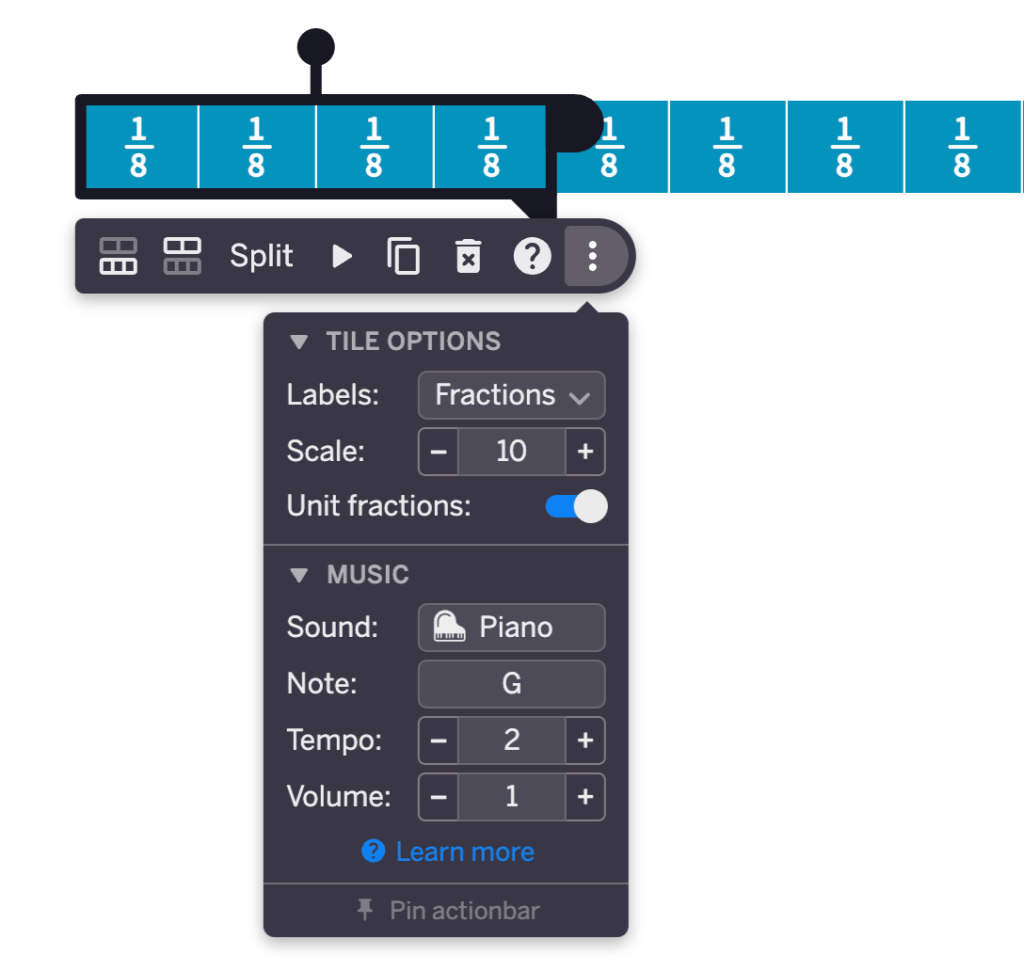
“We’re going to recreate the song using fractions in Polypad. So it goes eighth eight eighth eighth…”
I pulled up a bar of eight 
I was dragging them through it, but I was confident we’d have some pay off. Pretty soon, we’d created the following stream of fractions.

It was a good start! But it sounded bizarrely choppy. Every time it switched to a new chunk, there was a slight pause. I wondered if it had something to do with the setting. I had put everything on a tempo of 2 to speed it up, but there must be another way to speed it up without using that setting.
Double Time!
I told the kids we would try something called ‘double time.’ This meant that we would need to play everything twice as fast.
“Oh, so instead of an eighth for each note it’s two-eighths?” Grayson asked.
Hmm. I could see how this was confusing. We weren’t doubling the length of the note, but doubling the speed, which meant… halving the note. Inverse operations! I explained this to the kids.
“If you cut an eighth in half, it’s a… sixteenth?” Grayson’s words curled upwards in uncertainty, even though he was right. “And if we cut it in half again, they’re thirty-twos? Thirty-halfs?”
“Thirty-seconds,” I corrected. Words can be funny. “But let’s focus on those first eight notes. They aren’t eighths anymore if we are doing double time. They’re sixteenths.”
To make the sixteenths, which weren’t in our fraction bar toolkit on polypad, I pulled a string of eighths and separated them. Then I hit “rename,” and each eighth was split into half to make sixteenths. I then changed the notes to match the sheet music.
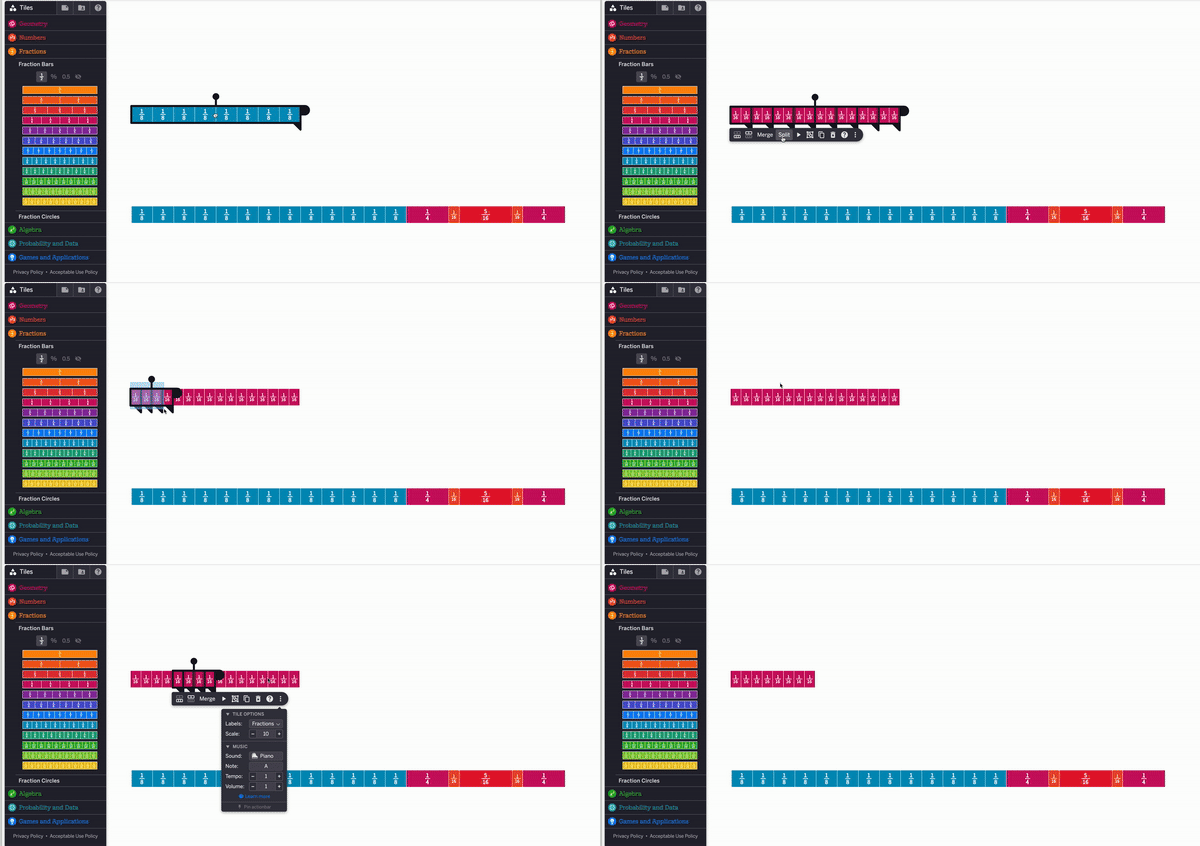
We worked together for the rest of the block, and then I added some left hand accompaniment during my lunch break.
I know, the audio is not great. For better audio, visit the actual “Drivers License” polypad and click “play.”
Triplets
Triplets are creeping up everywhere in pop music these days. (See: “How the triplet flow took over rap: The “Migos flow,” deconstructed,” by Estelle Caswell for Vox.)
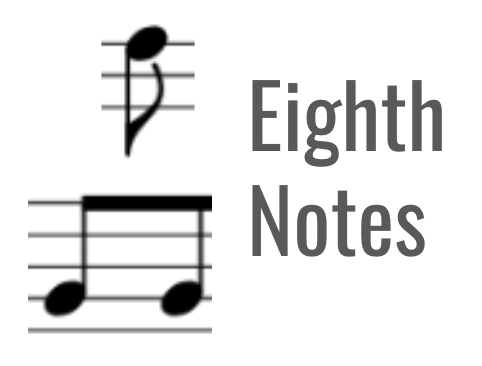
I had been emphasizing shape to indicate value. Eighth notes came in two forms: connected with a single bar, or with a singular tail. Sometimes the stem of the note was going up and sometimes it was going down, but those were the forms.
And then, a few measures into “Driver’s License,” and on our second day of working with the song, we hit some triplets.

These imposters looked like eighths, but there were more of them in a measure. “How many?”
Ava returned to the board to count, but Grayson beat her to it. “There’s four 3s, so that’s 12.”
“So each one is a twelfth?” Ava asked.
“Yes! But in double time, they’re going to be even smaller.”
“A twenty-fourth…”
I made the 
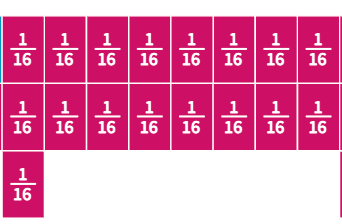

The measures with eighth notes (sixteenths) looked all neat and even. They matched up perfectly. The triplets (twenty-fourths) looked a little off beat. Syncopated.
“But they do catch up,” I explained. “How many twenty-fourths does it take to feel even again? Like we’re on the beat.”
“It looks like three of them makes two of the sixteenths.”
I wrote on the board:

“Is this a true statement?”
Ava and Grayson picked up their mini-whiteboards, and tried to use scale factors to check if they’re equivalent.
“How do I multiply 2 to get 3?” Ava asked. “Ugh, is this more fractions?” She started to push the whiteboard away, when Grayson stopped her.
“Look! They’re both eighths!” He proudly displayed his board:


“I divided the 3 and the 24 by 3 and got the 
“And they’re equivalent, and that’s why they line up!” Ava looked triumphant.
I explained that I’d do a little more work on the accompaniment later, and that we had a few other things to do with fraction addition, but that maybe we’d try a song of Grayson’s choosing in the next session.
Adding It Up
“I really only listen to rap,” Grayson told us in the next session. We quickly looked through some free sheet music, and I let him select that iconic piano intro from “Still D.R.E.” (We wouldn’t be listening to the lyrics, so… it was all good? I told my students that I can’t endorse the lyrics, but, I mean, my husband and I listen to this song all the time. Gotta tow the party line at work.)
The sheet music was actually pretty perfect for this next exercise. I wanted the students to practice some fraction addition with unlike denominators, and the pulsing staccato vamp at the beginning would be easy enough to translate into fractions, while the second part offered more syncopation and an opportunity to add some fourths and eighths. These were simple fractions to add, but it would lead us into work with ‘uglier’ fractions later.
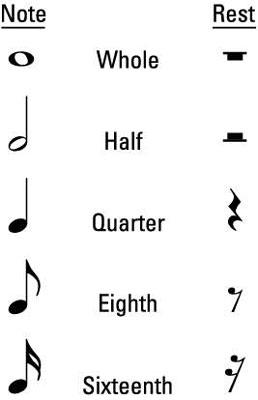
I reminded students about the shape of notes and rests (at left) and put the sheet music on the board.
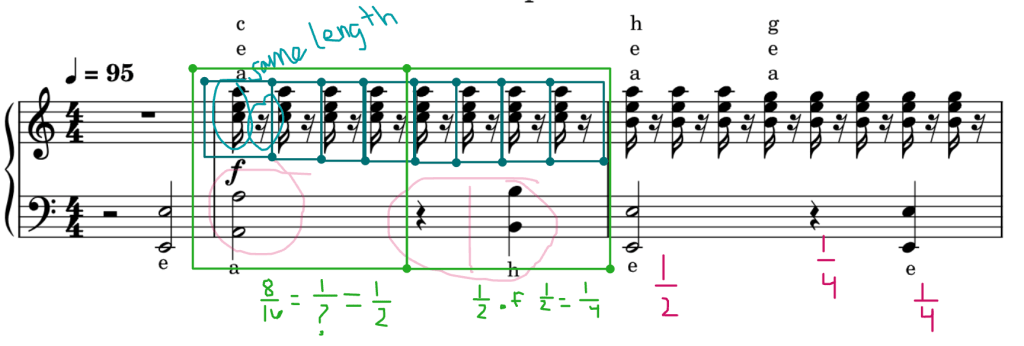
The sixteenth notes stood out, and the students wanted to start there. But I pointed out the rests at the beginning: in particular, let’s look at the left hand, which offered a half note rest and then a half note.
“That makes sense,” Grayson said. “
“And that’s exactly what we’re going to be doing with the sheet music today! We’re going to be looking at when the beats line up — when the fractions are equivalent — and confirm that we are making wholes with each measure, even when the notes aren’t all the same size or value.”
We examined how each sixteenth note paired up with a sixteenth note rest, to make eight scattato notes. The half note in the second measure lined up nicely with four of those pairs, which made for 

And then the next half measure was split into two equal size parts, a rest and a note. Each would be half of a half, or 

The next be trickier. I helped them diagram the right hand of this measure, a mixture of fourth and eighth note rests, and some actual eighth notes.

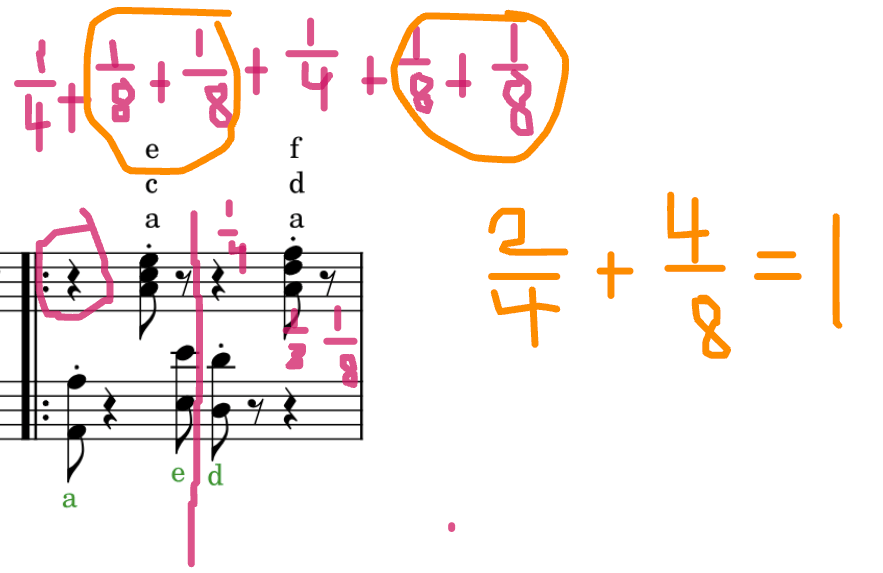
Ava and Grayson had different ways of solving it.
Grayson combined the fourths to get 

Ava had gone from left to right. “


“Oh, but then look at what comes next…”
We had been copying and pasting the fraction bars to recreate the sheet music more efficiently. It was much easier to make those repeated sixteenth chords with copy/paste. And our equation looked like it had also been copied and pasted!
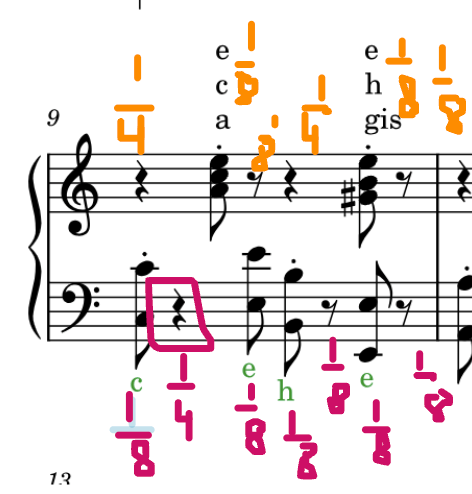
Ava was thrilled that she, too, had reduced her expression down to

We diagrammed one more measure to make certain we were, again, creating measures that added up to one whole.
While the students added, I finished adjusting the notes in polypad.
Grace Notes
Back at home, I showed my own children (eight-year-old S and six-year-old N) the seventh grade creations. They insisted that I make some songs for them, too.
So we did the beginning of “He’s a Pirate,” from Pirates of the Caribbean, to commemorate my son’s special interest in golden age piracy.
And “Despacito,” which I thought would be fun for all of the syncopation.
And my daughter requested Camilla Cabello’s “Havana.” (She had recently come across a biography of Camilla at school.) As I worked to translate “Havana” from sheet music to fractions, I came across some adorable little grace notes.
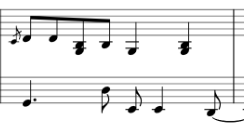
See that first note — much smaller, and it looks like it’s crossed out? That’s a grace note, which adds a little embellishment. In this case, it’s a transcription of a scooped vocal, going from the C up to the D.
But adding in a tiny note, like a 
I took the eighth note and split it up into sixthteenths… no, thirty-seconds… no, fourty-eighths. It created a little pack of 
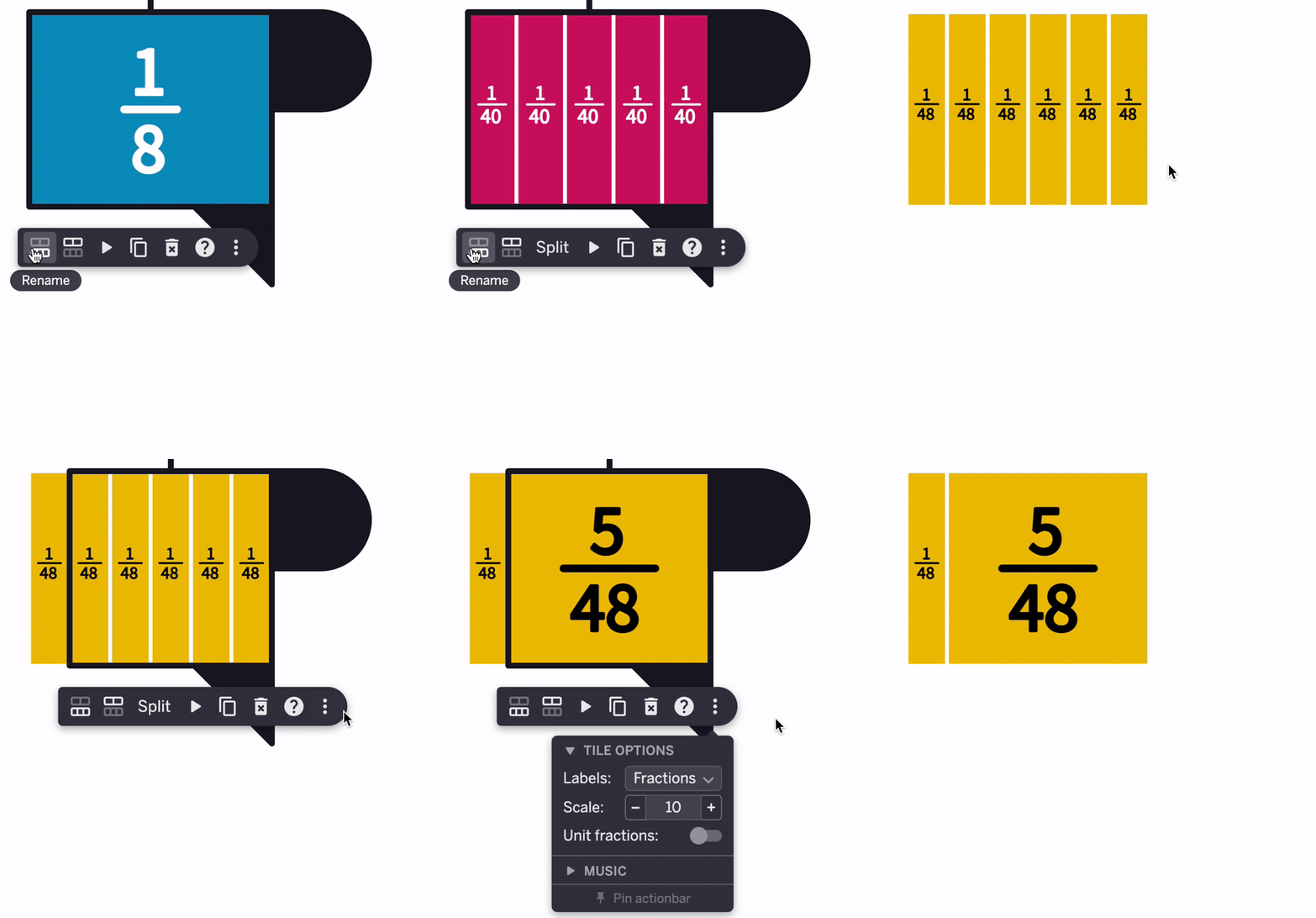
And you can hear grace notes all over the place in “Havana.” The song also has lots of tied notes, or notes that are connected to form a single note (e.g. an eighth note tied to a quarter note lasts for 
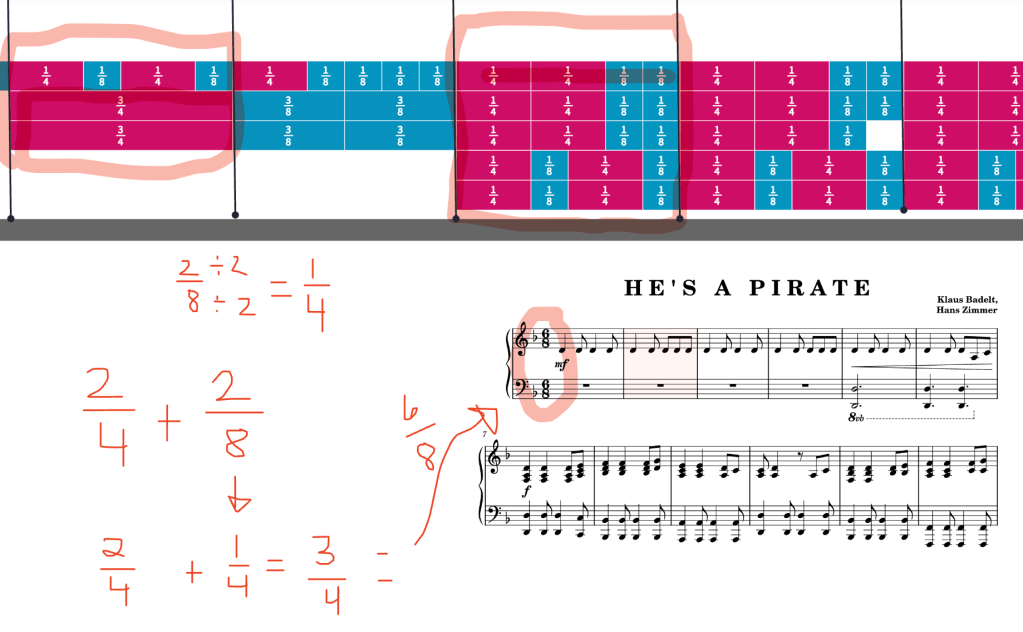
The more I translate songs into fractions on polypad, the more I see connections between the fraction content we teach and the musical notation. For example, most of the songs we were working with were in 

“

“And that’s just “

I pointed out that the time signature is
The seventh graders and I are going to continue on with Transition to Algebra, but, if I come across some fun sheet music that connects to the concept, I wouldn’t rule out creating more of these.
Some Songs to Check Out in Fraction Form (on Polypad)
Discover more from Jenna Laib
Subscribe to get the latest posts sent to your email.
 Jenna Laib
1 Comment