
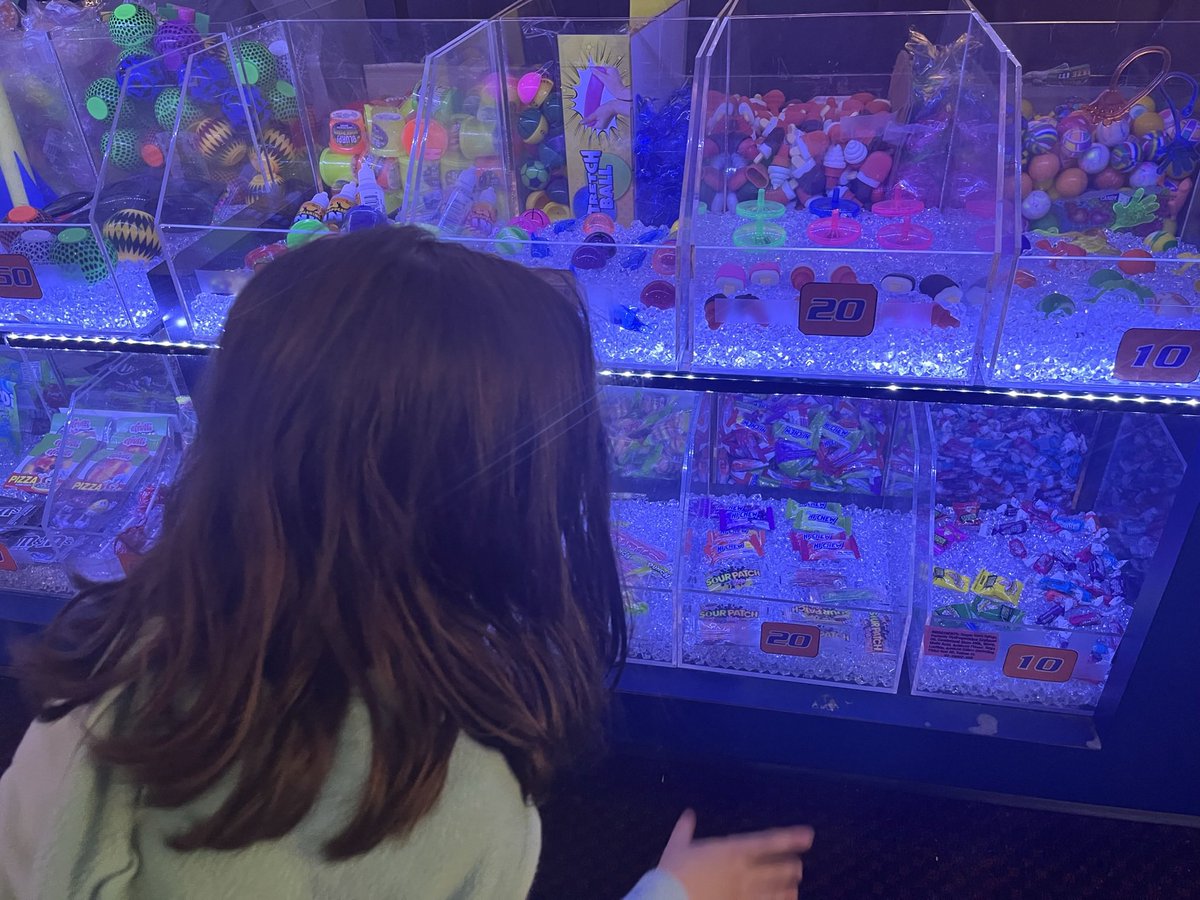
How many different ways can you spend your prize tickets?
My daughter, S, just finished first grade, where she worked on composing and decomposing both shapes and numbers. (Here are a few blog posts about first grade work: [1] [2] [3]) Decomposing numbers helps students to strengthen reasoning and strategies for addition and subtraction. For example, if you know that 5 is equal to 1 + 4, you could solve 9 + 5 as 9 + 1 + 4, or 10 + 4.
“Being able to decompose numbers within 10 is critical for reasoning numerical. When students become comfortable with decomposing numbers within 10, they no longer have to rely on counting on or back.”
Marilyn Burns, Listening to Learn
Composing and decomposing helps students transition from counting-based strategies to additive ones. Reasoning about how to decompose a number translates well to other mathematical ideas, like part-part-whole story contexts.
Anisa made 14 sugar cookies for a party.
Five of the cookies were shaped like hearts.
The rest were shaped like stars.
How many star cookies did Anisa make?
And understanding how to decompose numbers within 10 will make it easier to decompose larger numbers, especially when using place value.
Decomposing Numbers at the Arcarde
A few weeks ago, S attended a birthday party for a friend at a local party space that included an arcade. After playing a few games, S had amassed 55 points, which she could spend at the prize counter.
Ten points could net a bouncy ball, or a tootsie roll, or a stretchy hand. Double that, and she could get a neon plastic top, or an eraser shaped like ice cream. There were so many choices!
“Well, I want to get something for me and something for N,” she said. (N is her 5yo brother, who wasn’t at the party.) She carefully surveyed the display case, and say prizes for 10 points, 20 points, 30 points, 40 points, 50 points, and 100 points.
“What are you thinking?” I asked her.
“I’m thinking it’s annoying to have 55 points,” she responded.
“Why?”
“Because I can’t use them all.”
“Are you sure?”
“Yeah, these numbers are all 10s. Like 10, 20, 30. So I can only get more tens. I need a 5.”
I can appreciate her wanting to maximize her disbursal, even if, as an adult, I question the real world value of a sticky stretchy hand. We’ve got enough junk in our house, and I don’t need more things to “disappear” in the night.
“Hmm, you’re right. So what’s the greatest number of points you can spend?”
“I guess 50,” S sighed.
Decomposing 50
It was fairly easy for S to decompose the number 50, given the constraint that the parts must all be multiples of 10.
“If I want us to get the same thing, the biggest I can do is two 20s.”
“Oh, yeah, two 30s would be too much.”
“But I’d still have enough for a 10,” she mused. Sneaky. “Or I could do a 40 and a 10, or a 20 and a 30. Or a bunch of 10s!”
The table below lists out the ways S could spend her points. When making, I considered whether I wanted to list out combinations or permutations. Combinations means that. the elements can be listed in any order, e.g. 30 +20 and 20 + 30 are considered. the same, commutatively. Permutations means that the order of the elements matters, e.g. 30 + 20 would be different than 20 + 30. So below you see a list of combinations, because getting a 30 point prize and a 20 point prize feels no different than getting a 20 point prize and a 30 point prize. The order does not indicate ownership, e.g. the first number is for S and the second is for N.
| TWO ADDENDS | THREE ADDENDS | FOUR ADDENDS | FIVE ADDENDS |
|---|---|---|---|
| 40 + 10 30 + 20 | 30 + 10 + 10 20 + 20 + 10 | 20 + 10 + 10 + 10 | 10 + 10 + 10 + 10 + 10 |
And then within each solution, there are so many choices! There are several different 10 point prizes!
S brainstormed how she might want to spend the points aloud. The teenager working the prize counter smiled.
“Hey,” he said, crouching down slightly to meet S’s eyes. “Let me check how many points you have on that card.” He swiped it to confirm the 55 point total. “You know, I. can actually round that up to 100 points if you want.”
S nodded solemnly. I think she was pleased, although I knew. this also meant more math!
Decomposing 100
Making a table to show the possible ways to decompose 100 using the given prize denominations (10, 20, 30, 40, 50) would be so much more complex. There is only one way to use two addends: 50 + 50. From there, to make three addend combinations you could decompose one of the 50s into two parts (e.g. 50 + 40 + 10, or 50 + 30 + 20), and then there are other combinations that don’t have a 50 point prize, like 40 + 40 + 20 and 40 + 30 + 30.
I could see S’s brain swimming.
The Final Choice
Ultimately, S decided on a. vast array of prizes. First, she got a two pieces of candy (one for her, one for N) for 20 points each. Then a bouncy ball for 10 points.

Then she got a 40 point prize (play doh) and another 10 point bouncy ball.

Ultimately, she spent the 100 points by breaking it down into two groups of 50.

I think it was easier to hold this in her head, since she’d already worked out those ways to make 50.
In Reflection
As a parent, it was beautiful to witness S’s flexible thinking as she decomposed 50 and then pivoted to 100 points. She also wrestled with ideas about place value and tens (e.g. that she cannot combine any number of multiples of 10 to get a number that is not a multiple of 10, like 55).
As someone engaging in the math, I wonder if the constraints (only certain multiples of 10) made it especially interesting for me, because I could not quickly generalize the number of combinations for 100 points. I think S was primarily motivated by the fact that she was choosing out actual prizes.
As someone who works with other teachers and parents, I wonder how I can support others to see opportunities for mathematical play like this.
Discover more from Jenna Laib
Subscribe to get the latest posts sent to your email.
 Jenna Laib
1 Comment