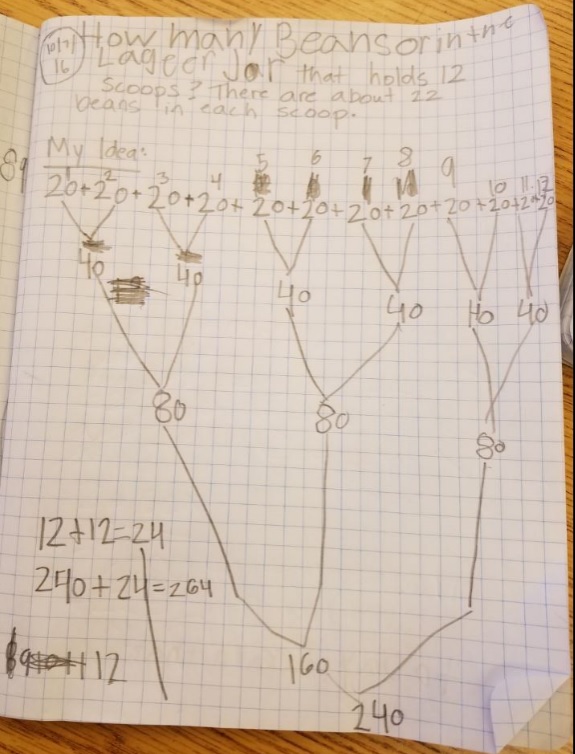
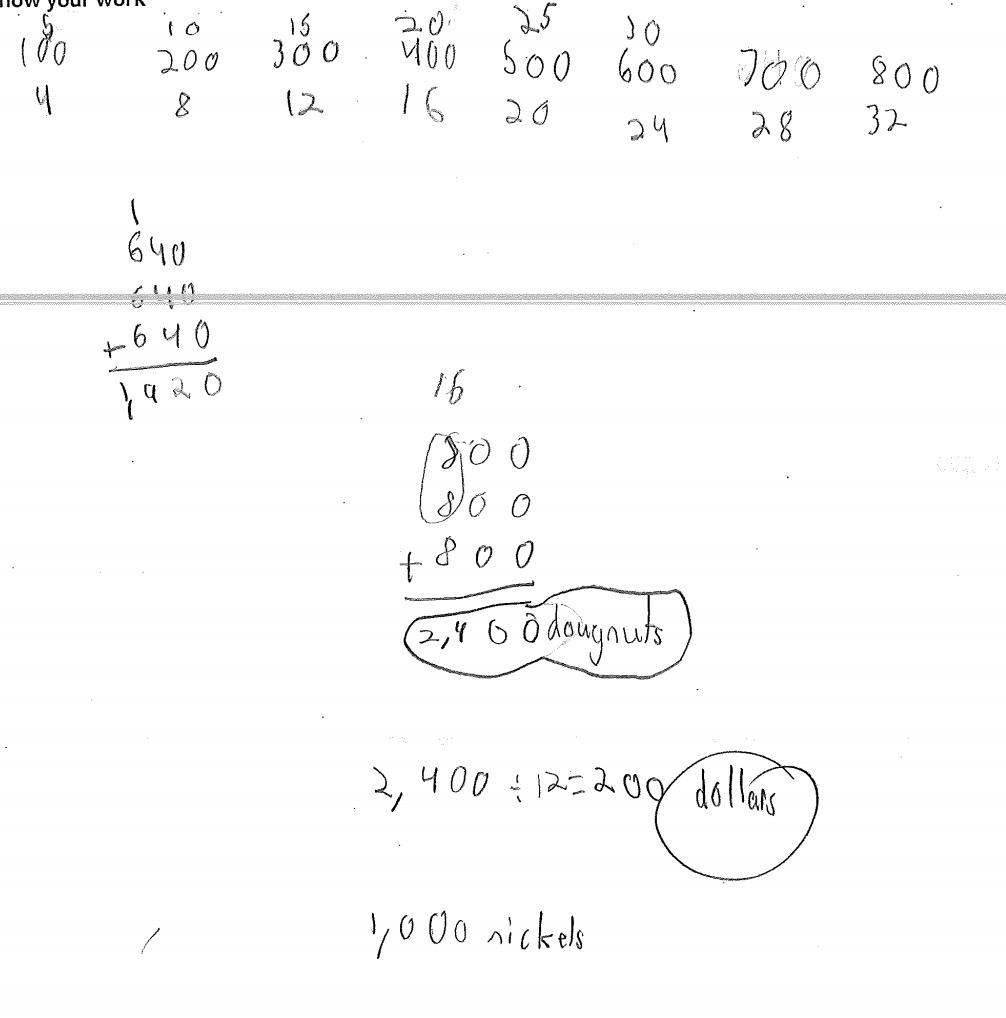
I come from the Marilyn Burns School of Student Work Samples — which is to say I prize student work that fills a large, blank page. (#TeamBlankSpace) Marilyn Burns, one of my math ed heroes, published a series books with exemplar lessons for elementary math that feature lots and lots of student work. I have poured over these books: the careful development of mathematical ideas, and the constant celebration of student ideas and agency. The students have the freedom to explore and space to represent their ideas.
how are students representing their own ideas in an online platform?
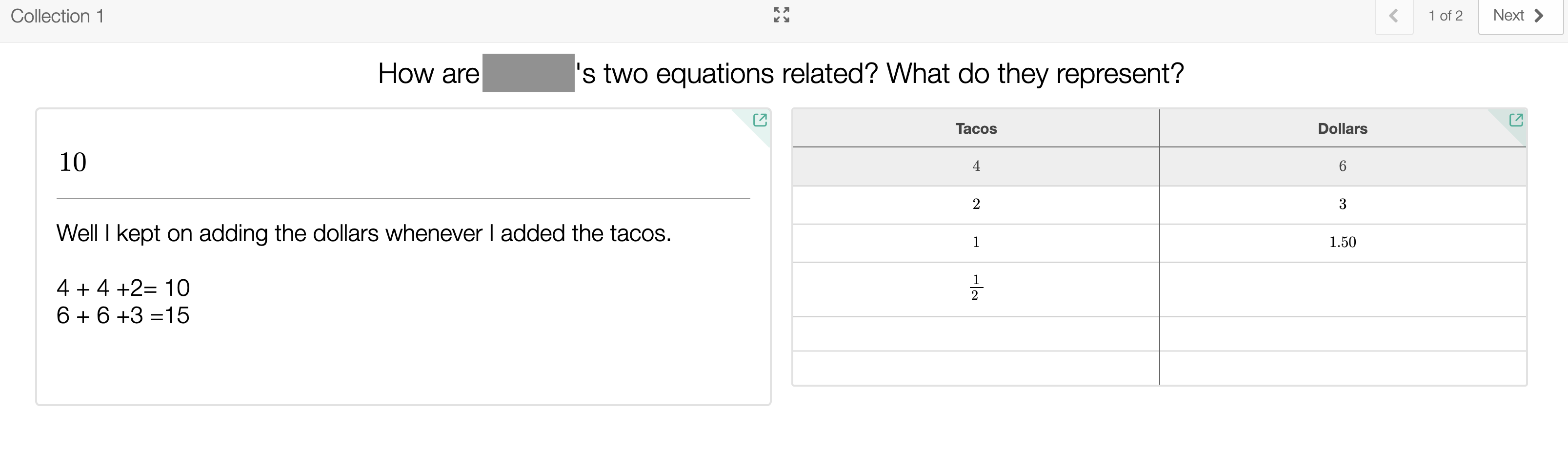
Now, my student work looks a lot more like this:
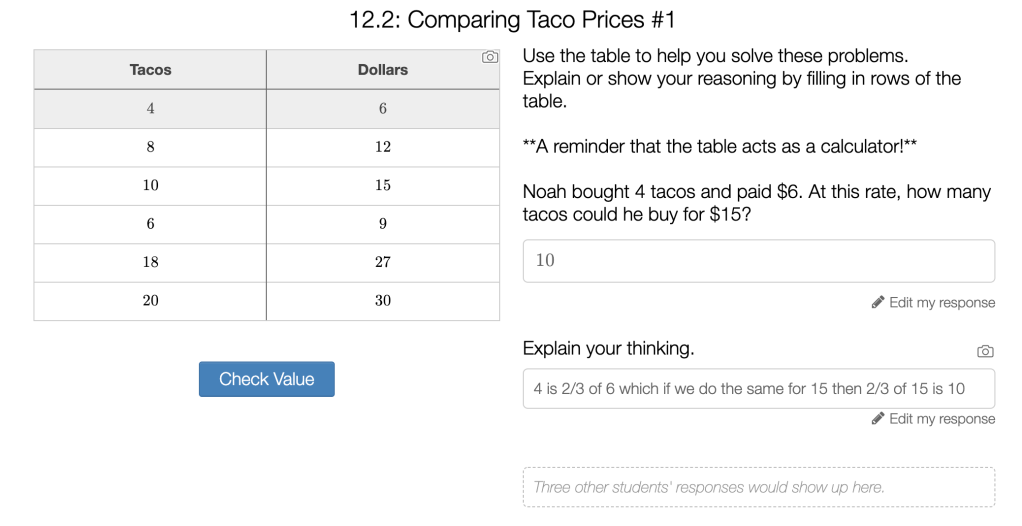
I am eternally grateful for Desmos. I do not know how I would do remote teaching without Activity Builder! That said, the student work samples look… different. I mourn the loss of paper and pencil. I’ve always had this instinctual idea that students do not show their thinking as well on a computer, which is one reason I prefer the paper and pencil version of our state exam.
That said: is the typing truly a hindrance to students? Does it prevent them from showing their thinking as well? How can different features of different platforms (e.g. using the sketch tool on Desmos, making videos, using jamboards, etc.) help students show their thinking in different ways?
I am still exploring these questions. In general, I have found that typing is harder than handwriting for students, but that they’ve adapted beautifully to the online medium, and that their ability to make their thinking visible online improves every day.
How can I help students show their thinking online?
During our activity and lesson syntheses (closing discussions), I share lots and lots of student work. We look at how students have written sentences to describe their thinking, or how they’ve used the sketch tool to add on. It’s not as natural as writing on a paper, but we are making it work.
Desmos also offers a “snapshot” tool so that I am able to add to different pieces of student work next to one another, with just a few clicks. Below is an example of my dashboard as I select student work, and add focus questions for discussion.
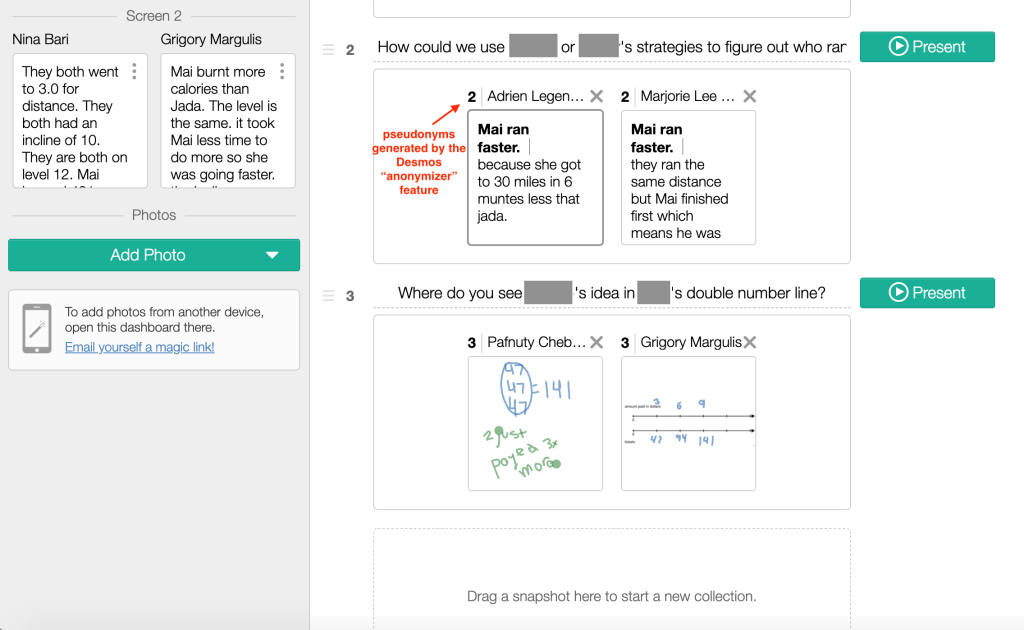
In the work sample below, the students were wrestled with how many tacos they could buy for $15 if 4 tacos cost $6. Students used the table in different ways. I shared a few, and we drew arrows to show the scale factor they used to determine the different number of tacos or cost. The student below had tried to show a different, additive idea.
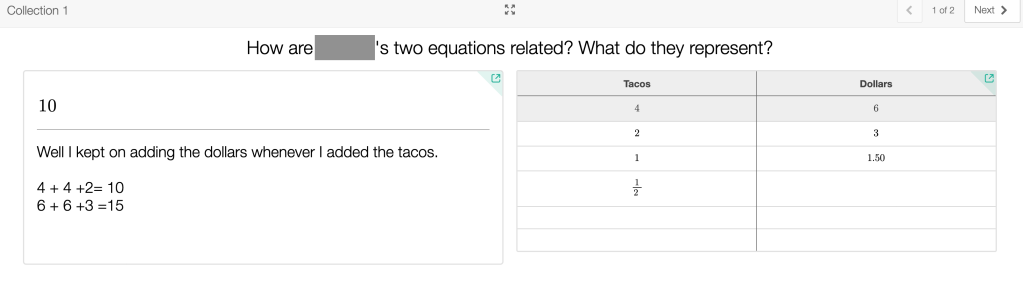
We examined her work. She read it the sentences, and students were able to ask questions or comment on what they saw. It can be so difficult to record some ideas without using the sketch tool, and it can be difficult still to represent ideas using the sketch tool when limited to a chromebook track pad.
But the more work we show, the more students develop a sense for what makes for clear mathematical communication.

How can I mitigate teacher bias during remote learning?
Another advantage is that I am truly forced to focus on the content rather than the organization and use of space. It is easy for teachers to develop bias (e.g. prefer neater work, regardless of the ideas represented) through these traditional work samples. (With gratitude to Idil Abdulkadir @Idil_A_ for pushing my thinking on this!) When I choose student work to snapshot and share during our class discussions (5 practice style), it is truly because of the content.
The Desmos “anonymizer” feature supports this work, too.
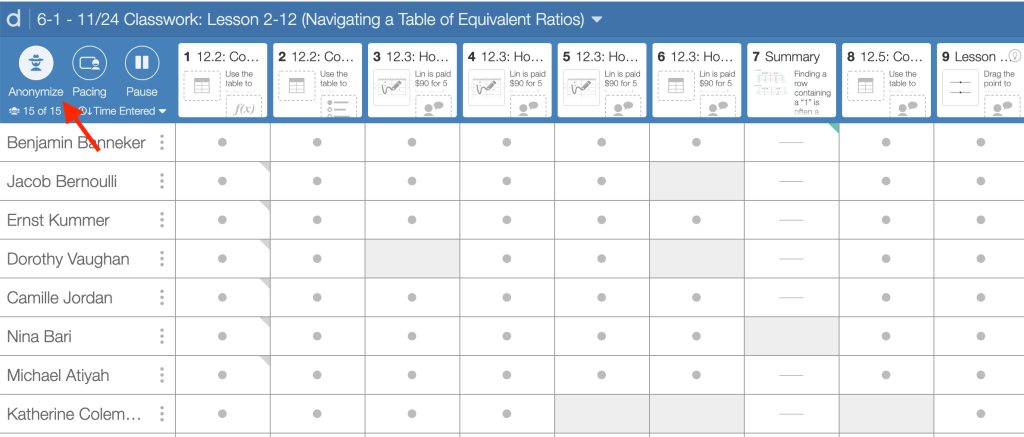
I do not use the anonymizer feature all the time. The most frequent time I use the anonymizer feature is when I’m sharing my screen with the class and do not want to reveal everyone’s work.
One of my goals is to amplify quieter voices, and to do that I need to make certain I am sharing their work. Sometimes I will choose a number of work samples, de-anonymize the work, and then choose from the pre-selected pool. I have only tried this a handful of times, though.
Another time I have tried to use the anonymizer feature is to examine student “cool downs” (exit tickets) without any bias about what I would expect from an individual. It’s easy enough for me to turn the feature off quickly so that I can also use context and what I know about that student.
The Power of Images
At a few parent-teacher conferences this week, parents asked me about having more self-grading assignments. I told them that often the assignments I give (via Desmos) are not exactly self-grading but instead offer feedback, whether it’s visual or the opportunity to try again. In the online environment, I think it’s especially important to focus on images and visible representations of student thinking, so that we can push back on a fully automized vision of mathematics education.
Discover more from Jenna Laib
Subscribe to get the latest posts sent to your email.
 Jenna Laib
1 Comment