
In early October, I presented at NCTM Hartford with the incomparable Heidi Fessenden (@heidifessenden / blog). Our session was called “Strategies for Cultivating Mathematical Thinking for All Learners.”


Slides available here.
The first blog post about this session is available here.
Within the presentation, we offered three strategies. Here is the first one.

- Naming the mathematical practices in student friendly language
to make clear what it means to think mathematically
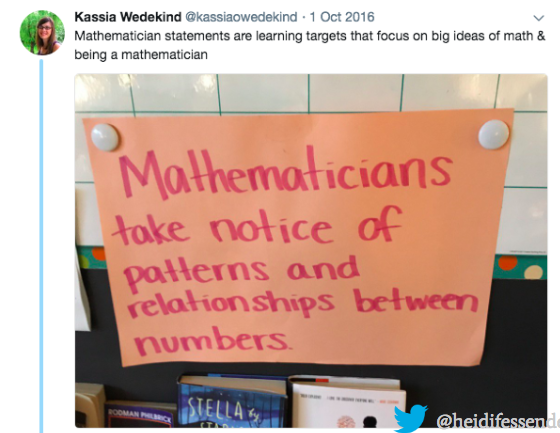
“Mathematician statements” parallel the “good reader” statements that elementary teachers may make during literacy. They illuminate and make explicit strong mathematical practices. Here’s a example from Kassia Wedekind (@kassiaowedekind)
Mathematician statements are learning targets that focus on big ideas of math & being a mathematician pic.twitter.com/QqC6LAlBSs
— Kassia Wedekind (@kassiaowedekind) October 1, 2016
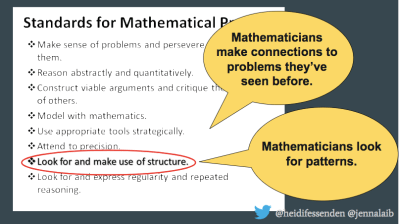
Heidi tried this out in a classroom last year. She crafted short, memorable mathematician statements, and used them repeatedly. She found that students started to internalize these statements, and use the statements themselves.
3rd grader in my intervention group: I’m going to think like a mathematician. I see a pattern!
— Heidi Fessenden (@heidifessenden) January 24, 2018
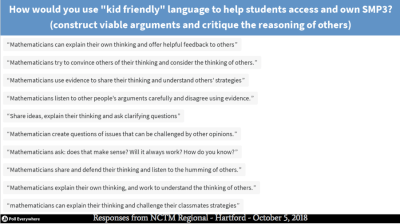
Participants in Hartford tried out crafting their own mathematician statements for SMP3: construct viable arguments & critique the reasoning of others. Here are a few live audience responses. There are more available on the slide deck.
Discover more from Jenna Laib
Subscribe to get the latest posts sent to your email.
 Jenna Laib
4 Comments